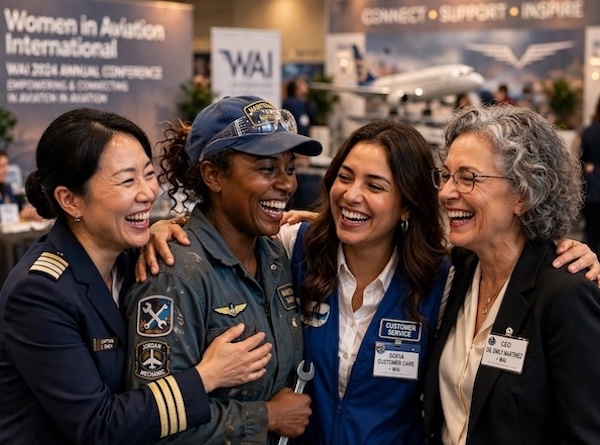
At the 2026 Women in Aviation International (WAI) conference in Dallas, nearly 5,500 people attended, including representatives from 28 countries. My attendance at the conference taught me that although I was different, I found people who understood me, and I discovered that I belong. I learned that my differences are useful. I felt that I can be myself here, I can contribute, I can disagree, I can learn, and I will still be regarded as one of us.
Female aviation professionals join WAI for a mixture of practical career reasons and professional community—not simply because they are women. There is a psychological dimension to WAI membership. A woman doesn't necessarily join because she believes she needs help because she is a woman. She may join because she wants access to people who understand a particular part of her professional experience.
One may enter WAI expecting: networking, professional contacts and aviation opportunities. What I discovered instead is: recognition, friendship, belonging and the opportunity to give something back. One of the hardest things to find is a place where achievement no longer separates from the people around one. Having dinner with five WAI colleagues after a conference makes one feel that one belongs to something.
At a WAI event, one sits down beside another woman and starts talking. Just: “Where are you from?” “What part of aviation are you in?” “How did you get into this?” One realizes: “These women aren't impressed by my degrees. They're interested in me.” That can be much more satisfying. Conversations can move quickly from: "What do you do?" to: "I had exactly the same experience when I was starting out." That is where professional networking becomes social bonding.
My experience was: I found people who understood me. I discovered that I belong. I discovered that my differences are useful. Now I can help connect two worlds. Belonging at its highest level isn't simply finding your tribe. It is eventually becoming someone who helps others find theirs. My differences are precisely what give me something valuable to contribute.
From age 17 until 2011, I competed in sports at the highest level. The highlight of my athletic career was winning the 2010 World Jiu-Jitsu Championship. Throughout that time, I balanced sports with my law studies—a combination that demanded perseverance, discipline, and complete focus. As a young woman, I did not realize I was building an extraordinary life. I simply enjoyed the challenges of sport and study. Over time, success taught me how to distinguish myself.
At the WAI conference, things that once contributed to feeling different become points of connection. For a woman who has spent much of her life being distinguished by her achievements, perhaps the most valuable experience is surprisingly simple: For once, I was not the woman with several degrees and several black belts. I was simply one of the women in the room.
When I entered law school and martial arts, I probably thought I was building a career and acquiring skills. Years later, I realized that I was actually building character.
I look back with gratitude. Not necessarily because everything was easy. Quite the opposite. I realize that the difficult people, difficult professors, difficult opponents and difficult circumstances all contributed something. Martial arts in particular can teach a person that the opponent isn't necessarily the enemy. The opponent is often the teacher you didn't ask for.
It is a remarkably useful philosophy for aviation—and for life. And remember that it was built one small step at a time. That may be one of the most valuable things I can communicate to younger WAI members.
I can stand in front of a room full of young aviation professionals and say something much more meaningful than: "Believe in yourself." I can say: "You don't have to know who you will become. You only have to be willing to become better than you were yesterday." Looking back at my younger self, I think that I had no idea what she was capable of. That, to me, is where belonging, encouragement and role modelling come together at WAI.
The young woman sees the accomplished woman and thinks, “Perhaps I can.” The accomplished woman looks at the young woman and remembers, “That was me.” It creates something much powerful: a bridge between generations of women in aviation, psychological message: “If she did it, perhaps I can do it too.”
Who am I to say this. I’m not a female airline captain, CEO or engineer as an exception. I couldn’t claim that I was an aviation expert of any trade. I operated drones for video and photography. So, call me a drone pilot. I became aware of the unruly passenger problem. My solution against occurring violence was to apply martial jiu jitsu elements. I had already been a self-defense trainer for many years and developed safety manuals for law enforcement agencies. And so, I entered the field of creating safety programs for aircraft cabins and on airports.
The “sense of belonging” is deeper than simply feeling welcome. In the case of, it means that a woman can enter a professional environment and feel: “These are people who understand my world. I am not an outsider here. I have a place here, and what I contribute matters.”
When the WAI conference ended, the ocean was still between me and most of the people I had just discovered. Having discovered a place where I can simply belong, then one realizes that living on a small Caribbean island makes that belonging more complicated. A conference can provide an intense sense of belonging for a few days, and then one returns to an island where there may be very few people with comparable professional backgrounds.
But my position from a remote WAI member could change into a bridge-builder. This may be where my position becomes especially valuable. I am not simply another member from a large aviation market. I have a perspective that many members in North America or Europe may rarely encounter. On a small Caribbean island, aviation isn't merely an industry. It can be a lifeline. Maybe I can be WAI's connection to a part of the aviation world that is often underrepresented. I could introduce WAI members to some of the realities of Caribbean aviation. And I could bring WAI's knowledge, networks and opportunities back to Caribbean women.
Jiu-Jitsu may offer some unusually good lessons for private and business aviation, because both involve performance under pressure, discipline, preparation, humility, and making good decisions when ci...