



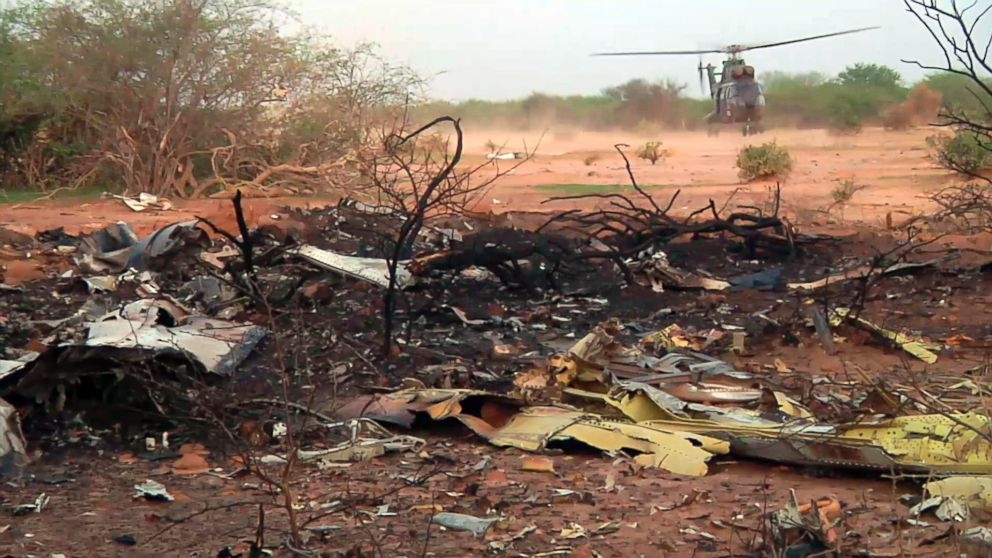
Investigators into the crash of an Air Algerie flight in Mali that killed 116 people in 2014 have called for expanded anti-icing protection and better procedures and training after the pilots lost control while trying to avoid a storm.
A final report by France's BEA agency, presented in Mali and Paris, focused on the way pilots responded to problems initially caused by the icing of vital probes, partly echoing the crash of an Air France airliner over the Atlantic in 2009.
After an investigation lasting almost two years, the BEA said it could not exactly explain the crew's actions because of a faulty and damaged cockpit voice recorder.
However, it confirmed earlier findings that an anti-icing system had been left switched off as the plane flew from Ouagadougou, Burkina Faso's capital, to Algiers at night, before crashing in the remote desert of eastern Mali on July 24.
"The plane tried to avoid a storm area," Malian Transport minister Mamadou Achim Koumaré said, presenting the report in a news conference in Bamako.
"There was some icing in the aircraft's engine ... and it's at that time that the plane made a left turn and plunged."
Of the victims, 54 were French citizens, and the BEA helped Mali investigate the crash of the McDonnell Douglas MD-83 jet.
The 170-page report is the latest response to a series of accidents in which a combination of factors led to a high-altitude stall or loss of lift, prompting calls for better training for pilots in the air and in simulators.
The BEA said the crew may have been distracted by the storm as well as problems in communicating with air traffic control.
It found no sign that they responded to subsequent warning signs that the aircraft was losing lift, which include tell-tale wing vibrations and deliberate alarms inside the cockpit such as the automatic shaking of the control column.
Pilots are meant to push the stick forwards and lower the nose to pick up speed in order to correct a stall, but the BEA said it had discovered a "lack of appropriate inputs on the flight controls to recover from a stall situation".
It also suggested cockpit stall warnings woke up "belatedly" because of the logic that governs the way they are triggered.
It recommended U.S. planemaker Boeing, which now owns the company that built the 18-year-old jet, should look at installing a permanent anti-icing system and changing the logic of some systems.
It also called for improvements in the way simulators are designed for the aircraft, which is no longer in production.
Boeing was not immediately available for comment.
For the fourth consecutive year, Corsair is reaffirming its commitment to the fight against breast cancer by partnering with the association "Les Hôtesses de l’Air cont...
FL Technics Indonesia, the first MRO in Indonesia to be appointed as a GE Aerospace avionics support partner, has signed a service support agreement with GE Aerospace covering Boeing 737 and Airbus A3...
The International Aircraft Dealers Association (IADA) has released its 2026-2027 Current Market Portrait & Forecast, offering an in-depth analysis of the global preowned business av...
As the first aviation company in Kansas to introduce state-registered youth apprenticeships through the Kansas Office of Apprenticeships, Textron Aviation is taking a leading role in workforce develop...

