



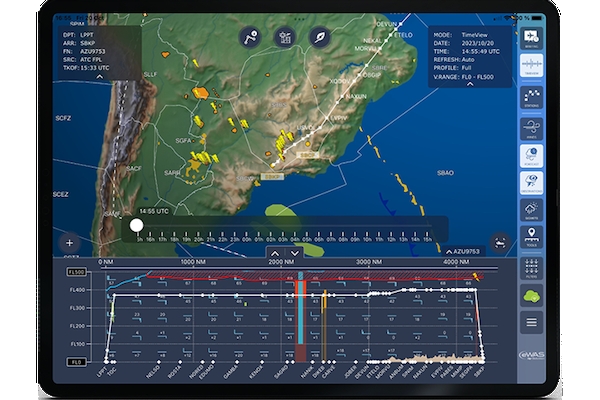
Azul entered into a trial agreement for SITA eWAS and SITA OptiClimb. This trial will assess the performance and potential benefits of both systems. Azul is actively using SITA Mission Watch, making it the first airline in the Americas to do so. By collaborating with SITA, Azul is already achieving significant cost savings, reduced carbon emissions, and improved operational efficiency, resulting in reduced aircraft downtime due to weather disruptions across its fleet of 177 aircraft.
Daniel Tkacz, Operational VP of Azul, said: "SITA has been our DataLink service provider since 2009, and during this period, they have proven to be a reliable and trustworthy partner. They have invested time and effort into our business and actively contributed to our sustainability initiatives. As we continue to pursue greater operational efficiencies, we believe there is no better partnership to keep us at the forefront of technological advancements."
Yann Cabaret, CEO of SITA FOR AIRCRAFT, said: “By kitting themselves out with SITA OptiFlight, SITA eWAS and SITA Mission Watch, Azul is undoubtedly enhancing its fleet to be even more efficient and setting a new standard for the industry in Latin America and beyond.”
A significant proportion (up to 75%) of air traffic delays result from adverse weather conditions, costing airlines billions each year in additional fuel expenses, crew costs, and maintenance expenses. SITA's renowned weather awareness tools, SITA Mission Watch and SITA eWAS, are trusted by over 50,000 pilots and dispatchers globally and are now poised to have a substantial impact on Azul. SITA estimates that airlines can reduce the time aircraft spend on the ground due to weather delays by up to 60% if they have access to the right solutions.
Both SITA Mission Watch and SITA eWAS uniquely offer multi-source weather feeds, delivering accurate 4D weather forecasts and real-time updates from various sources to preemptively warn about weather hazards, such as thunderstorms, lightning, clear-air turbulence, strong winds, icing, and even volcanic ash.
SITA OptiFlight optimizes all phases of a flight, including climb, which is the most fuel-intensive phase of any flight. For Azul, this translates to an average annual fuel saving of 5% during climb-out on each flight. SITA OptiFlight achieves this because it is the industry's only machine-learning solution providing optimized climb speeds and acceleration flight level recommendations for every climb. SITA OptiFlight draws on tail-specific performance models fed with 4D weather forecasts and operational flight plan inputs to predict fuel-burn scenarios.
While SITA Mission Watch is tailor-made for dispatchers, SITA eWAS and SITA OptiFlight® support pilots. Together, they enable more innovative and cost-efficient flight operations for Azul.
Boeing and Ethiopian Airlines have announced a new cargo fleet expansion agreement, with the African carrier ordering eight 777-8 Freighters and two additional 777 Freighters. The investment will enab...
Dutch flag carrier KLM, part of the Air France-KLM Group, has welcomed its first Airbus A350-900, marking a significant step in the airline’s long-haul fleet modernization strategy. The arrival...
Emirates has officially inaugurated services to Helsinki, marking a significant milestone in connectivity between Finland and the United Arab Emirates. The new daily route is the only year-r...
flyadeal, the fast-growing low-cost carrier of Saudia Group and one of the GCC's largest budget airlines, has expanded its presence in India with the launch of non-stop flights between Riyadh and...

