



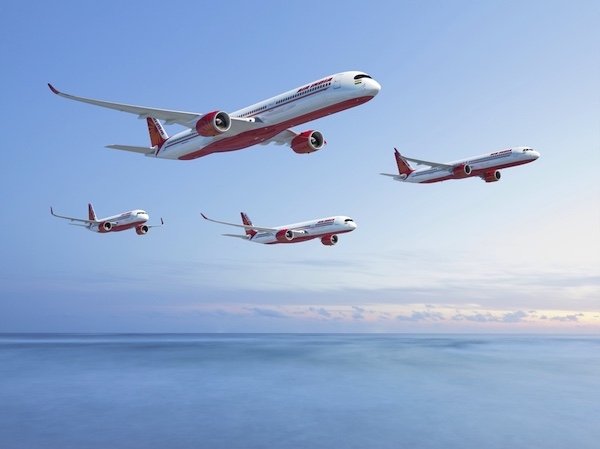
The Tata Group-owned Air India commits to order 250 Airbus aircraft to boost its domestic and international operations. The commitment includes 140 A320neo and 70 A321neo single-aisle aircraft as well as 34 A350-1000 and six A350-900 wide-body jets that will mark a new era for the country as the all-new, long-range aircraft celebrates its debut in the Indian market. The order aims to both modernise and expand the airline’s fleet with the objective of creating a larger and premium full-service carrier that will cater to the growing travel demand in the region. Deliveries are set to commence with the first A350-900 arriving by late-2023.
Campbell Wilson, CEO and MD, Air India, commented: “Airbus has been a longstanding partner of Air India, and these new aircraft will play an important part in delivering Vihaan.AI, Air India’s comprehensive transformation and growth strategy. A core element of this transformation is the significant expansion of our network, both domestically and internationally, coupled with the elevation of our on-ground and onboard product to world-class standards. This order marks the start of a new chapter for both Airbus and Air India.”
Christian Scherer, Airbus Chief Commercial Officer and Head of International, said: “This is a historic moment for Airbus and for Air India. India is on the verge of an international air travel revolution and we are honoured that our partnership with the Tatas and our aircraft solutions will write that new chapter for the country’s air-connectivity. The A350’s unique capability will unlock the pent-up potential of India’s long-haul market, its technology, long reach and second to none comfort will enable new routes and passenger experience with better economics and enhanced sustainability. Alongside the A350s, the A320 Family fleets will be the efficient, versatile asset to continue democratising and decarbonising air travel in the country – from domestic, regional, up to international levels. We salute Air India for its visionary strategy, picking the two reference aircraft types in each of their categories. We are thrilled and humbled to see these aircraft become the cornerstones of Air India’s renaissance. This fleet will propel the airline globally where it deserves to be - with the best.
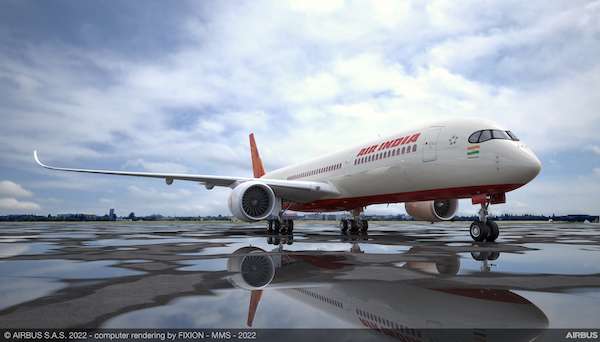
Over the next decade, India will grow to have the largest population in the world, its economy will expand the fastest among the G20 nations, and a burgeoning middle class will spend more on air travel. As a result, passenger traffic in India will grow fast, including on the long-range markets in the U.S., Europe and Asia-Pacific that the A350 is well positioned to serve.
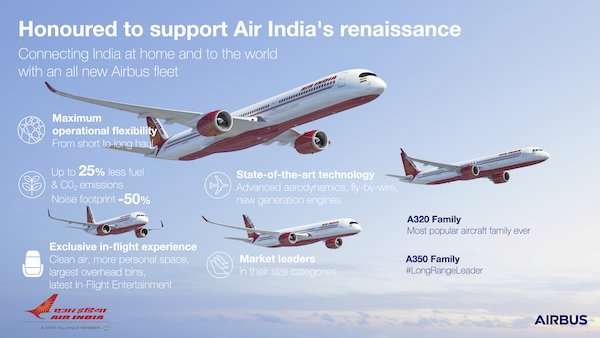
The A350 is the world’s most modern and efficient wide-body aircraft in the 300-410 seater category. The A350’s clean sheet design includes state-of-the-art technologies and aerodynamics delivering unmatched standards of efficiency and comfort. Its new generation engines and use of lightweight materials bring a 25 per cent advantage in fuel burn, operating costs and carbon dioxide (CO2) emissions, compared to previous generation competitor aircraft.
The aircraft offers a 3-class configuration cabin that is the quietest of any twin-aisle and offers passengers and crew the most modern in-flight products for the most comfortable long-range flying experience.
The A321neo is the longest-fuselage member of Airbus’ best-selling, single-aisle A320 Family, comfortably seating 180 to 220 passengers in a typical two-class layout, and as many as 244 in a higher-density arrangement. The A320neo has already set the standards as the world’s most comfortable short-to-medium-haul aircraft that typically accommodates from 140 to 170 passengers, with a maximum capacity of up to 180 travellers. Its environmental performance allows for at least 20 per cent less fuel burn and CO2 emissions as well as 50 per cent noise reduction, compared to previous generation aircraft.
Embraer reported a record backlog of US$35.7 billion in the third quarter of 2026, surpassing its previous all-time high by 3% quarter-over-quarter and increasing 14% compared with the...
The U.S. Federal Aviation Administration has certified the Boeing 737-10, the newest and largest member of the 737 MAX family, paving the way for Boeing [NYSE: BA] to begin customer deliveri...
MTU Maintenance and Garuda Indonesia have entered into a three-year agreement for the maintenance, repair and overhaul of the airline’s GE90-115B engines, which power its fleet of eight Boeing 7...
Bombardier marked the 40th anniversary of its industry-leading Smart Services cost-per-flight-hour programs, which today support more than 1,500 enrolled aircraft and account for over 11 mil...

