



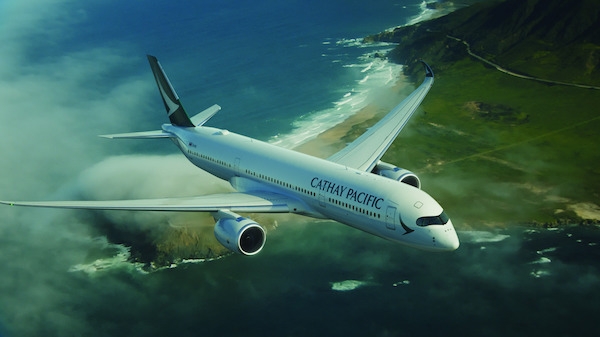
Cathay has further demonstrated its unwavering dedication to decarbonising the aviation industry, setting a new target to improve its carbon intensity by 12% from the 2019 level by 2030. This move reinforces Cathay's aspiration to be at the forefront of sustainability leadership and will support its overarching goal to achieve net-zero carbon emissions by 2050.
The new near-term target aims to improve carbon intensity by reducing the carbon emissions from Cathay’s jet fuel use per revenue tonne kilometre (RTK) from 761 gCO2/RTK to 670 gCO2/RTK. To achieve these improvements, more than 70 new passenger and freighter aircraft, which can be up to 25% more fuel efficient compared with the previous generation, will be joining Cathay’s fleet over the coming years.
Chief Executive Officer Ronald Lam commented: “Despite being a major airline with one of the best carbon intensity performances in the world*, we are determined to improve our climate performance even further via accelerating the use of sustainable aviation fuel, modernising our fleet and driving operational improvements. This new carbon intensity target will provide necessary drive for actions in the immediate future towards achieving our long-term goals.”
Accelerating the use of Sustainable Aviation Fuel remains the most important lever for achieving the new target and net-zero operations in the long run. Taking one step further to scale up SAF usage on all fronts, Cathay will use SAF to offset 10% of the carbon emissions from employee duty travel on Cathay Pacific flights from 2024 onwards. Since 2007, Cathay has been offsetting all emissions from employee duty travel on flights with the airline using carbon credits through its voluntary carbon offset programme, Fly Greener. This new endeavour is in line with its pioneering position in accelerating the development and deployment of SAF in the region and, more importantly, contributing to its 10% SAF usage by 2030 goal.
As one of the first airlines in Asia to set a target of 10% SAF for its total fuel consumption by 2030, Cathay fully recognises the challenges in transitioning to more sustainable energy in aviation. To address this, Cathay embraces a collaborative ethos, Greener Together, urging all stakeholders to unite in this important pursuit. To support this mission, Cathay has undertaken a multi-pronged approach to forge strategic partnerships with like-minded organisations and stakeholders along the SAF value chain. This includes the introduction of Asia’s first major Corporate SAF Programme for corporate customers to make use of SAF in reducing their aviation-related indirect emissions, as well as co-initiating the launch of the Hong Kong Sustainable Aviation Fuel Coalition earlier this year.
Etihad Airways has signed an interline agreement with Nigerian airline Ibom Air, enabling travellers to connect seamlessly beyond Lagos and Accra to five destinations across Nigeria on a single t...
British Airways has unveiled the next phase of its Heathrow lounge transformation programme, marking the beginning of a significant investment aimed at modernising every lounge across the airport in t...
For the fourth consecutive year, Corsair is reaffirming its commitment to the fight against breast cancer by partnering with the association "Les Hôtesses de l’Air cont...
PAL-V has signed a Memorandum of Understanding with AVION, a specialist in advanced flight training devices, and FLYVE, a developer of FlyDrive ecosystems for professional and government operator...

