



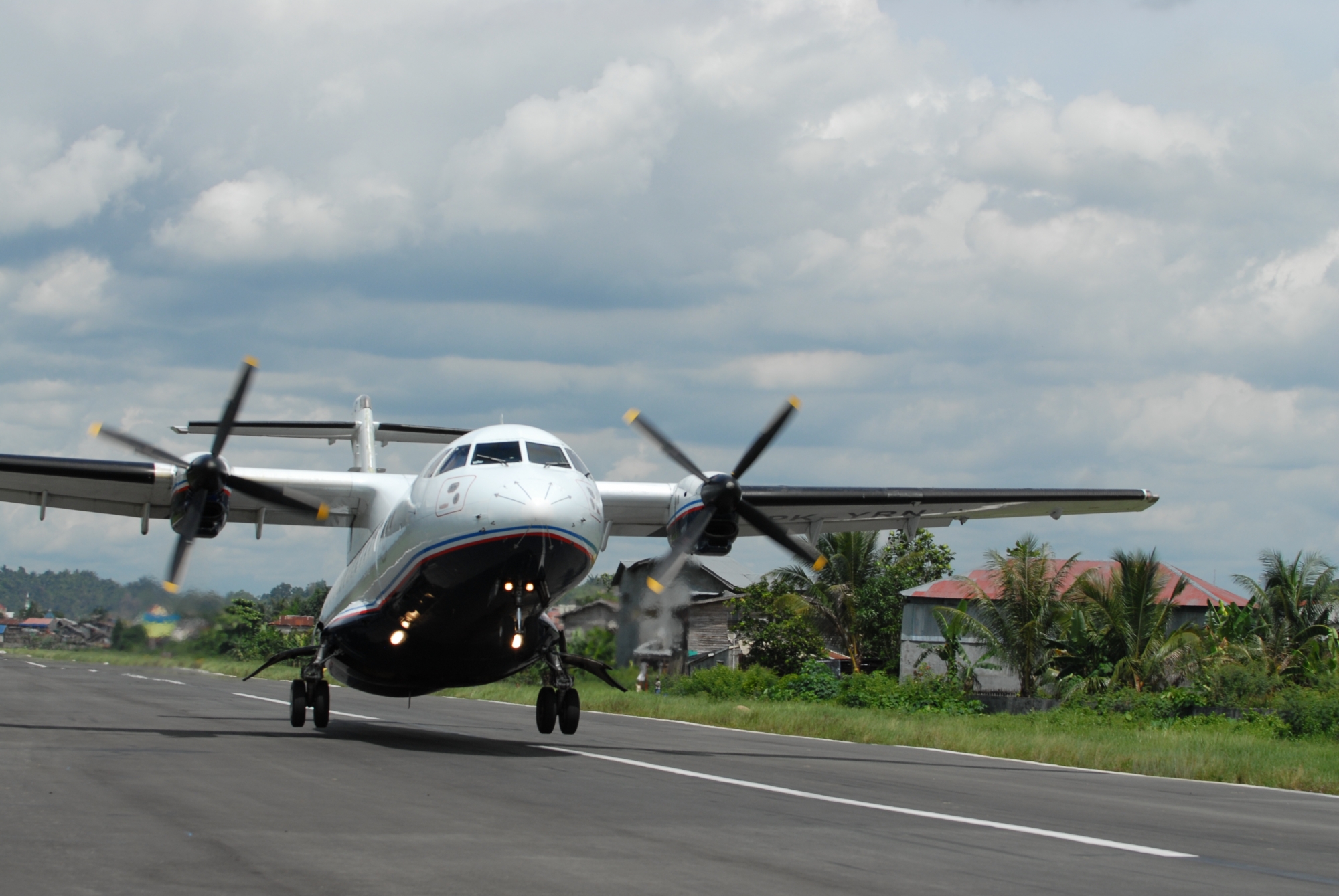
A preliminary report into to the fatal crash of a Trigana Air Service ATR 42-300 on 16 August indicates that the crew received no ground proximity warning system (GPWS) alerts before crashing into an 8,300ft ridge.
The National Transportation Safety Committee’s (NTSC) initial report into the crash, which killed 49 passengers and five crew, is based on data from the aircraft’s cockpit voice recorder (CVR), which Indonesian authorities successfully downloaded.
CVR data also indicates that the crew was not performing checklist procedures at the time the aircraft impacted the terrain.
The crash occurred while the aircraft, registered PK-YRN, operated flight IL267 from Sentani to Oksibil in Indonesia’s mountainous Papua province. At the time of the crash the skies were mostly clear with broken clouds at 8,000ft, with moderate winds blowing at 110 degrees and 8kt.
The aircraft had departed at 15:04 local time, and contacted the Oksibil Aerodrome Flight Information Services (AFIS) at 15:55, reporting that it was cruising at 11,500ft over waypoint ABMISIBIL. The controller acknowledge the message, and the pilot said the aircraft would fly a direct base leg routing to runway 11, which sits at an elevation of 4,000ft in a valley.
NTSC
Five minutes later, the AFIS officer had yet to hear from the aircraft, which should have been on final to runway 11. He tried to contact the aircraft but received no reply. Calls to other airfields nearby revealed that PK-YRN had not diverted. Search and rescue services were activated, but only on 17 August was the wreckage located.
Apart from the CVR revelations, the report sheds little new light on the causes of the crash. Indonesian authorities were unable to download information from the flight data recorder (FDR). This will be undertaken by the BEA in France.
The NTSC, however, issued several recommendations. It stressed that Trigana flight crews need to comply with company procedures such as briefings, checklist reading, approach procedures and visual flight rules minima, as well as monitoring.
It also recommends that Trigana “ensure the maintenance data record is up to date and includes the installed components.”
The report revealed that the pilot-in-command was 60 years of age and had over 25,000 hours of flight experience, of which 7,340 hours were on ATR aircraft. The 44 year old first officer had 3,800 flying hours, and 2,640 hours on ATRs.
A final report will be issued on 16 August 2016.
Bombardier marked the 40th anniversary of its industry-leading Smart Services cost-per-flight-hour programs, which today support more than 1,500 enrolled aircraft and account for over 11 mil...
Affinity Aviation Group (AAG), a leading provider of business aircraft sales, acquisitions and charter solutions, has entered into a strategic collaboration with Austria’s AeronautX, reinforcing...
MTU Maintenance and Garuda Indonesia have entered into a three-year agreement for the maintenance, repair and overhaul of the airline’s GE90-115B engines, which power its fleet of eight Boeing 7...
Air Baltic Corporation AS , Latvia’s national airline and the leading carrier in the Baltic States, announced that airBaltic and its subsidiaries participating in the voluntary Ch...

