



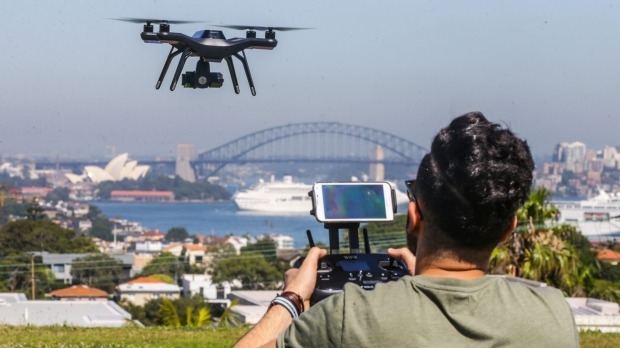
Commercial drone operators will no longer need remote pilot licences or certificates to use the unmanned aircraft on certain flights when new laws come into force later this year.
The relaxed regulations, due to come into force in September, are part of the Civil Aviation Safety Authority's plans to "cut red tape" and accommodate rising popularity in the remote piloted aircraft sector in Australia.
The commercial operators of the newly-created category of "very small" craft – those weighing less than 2 kilograms – will only need to notify authorities about their plans for certain flights, replacing the current system requiring across-the-board licence and certificate verification.
Licence-free commercial pilots would need to keep the craft below 120 metres, 5.5 kilometres from controlled airports and only within a daytime line of sight.
Privacy provisions, requiring drones to be at least 30 metres from other people, will not change under the new regulations.
Drones would need to stay clear of emergency zones, a provision designed to address concerns about the risks hobby unmanned craft pose to firefighting aircraft.
Landowners would also be permitted to fly drones weighing 25 kilograms or less over their property without official approval, provided nobody is paid for the operation.
Governor-General Sir Peter Cosgrove signed off on the changes to regulations late last month, with the amendments scheduled to come into force on September 29.
CASA aviation safety director Mark Skidmore said the changes were designed to balance safety standards with the lightening of regulatory requirements.
"The amended regulations recognise the different safety risks posed by different types of remotely piloted aircraft," he said.
"People intending to utilise the new very small category of commercial operations should understand this can only be done if the standard operating conditions are strictly followed and CASA is notified."
Anyone caught breaching the standards could face a maximum $9000 fine. Only one person has been charged in Australia so far for an illegal drone flight.
In a statement, CASA said it would provide an "easy-to-use" online notification system for commercial drone operators in the very small category.
"While safety must always come first, CASA's aim is to lighten the regulatory requirements where we can," Mr Skidmore said.
Airservices Australia is also exploring the possibility of tiered zones governing limited drone use within current out-of-bounds areas surrounding airports.
The possible change, discussed at a remote piloted aircraft systems conference in Canberra last month, would identify safe areas within the restricted 5.5 kilometre radius surrounding controlled aerodromes where drone pilots would only need to inform Airservices before flying rather than request permission from them.
British Airways has unveiled the next phase of its Heathrow lounge transformation programme, marking the beginning of a significant investment aimed at modernising every lounge across the airport in t...
Tecnam introduces the P2008JC NG to the United States market, bringing flight schools a certified, next-generation training aircraft designed to dramatically reduce operating costs while maximizing fl...
FL Technics Indonesia, the first MRO in Indonesia to be appointed as a GE Aerospace avionics support partner, has signed a service support agreement with GE Aerospace covering Boeing 737 and Airbus A3...
Following the successful public flight demonstrations at Expo 2025 Osaka, SkyDrive announced plans to undertake a feasibility study exploring the conversion of Osaka City’s existi...

