



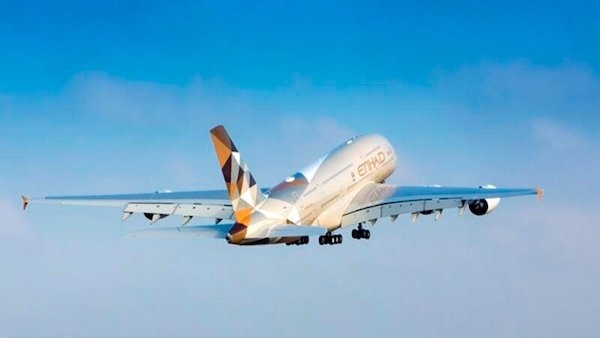
Etihad Airways continues to reduce carbon dioxide emissions by implementing fuel saving initiatives, reinforcing its commitment to sustainability.
Following a number of improvements aimed at enhancing operational fleet efficiencies, Etihad Airways reduced 148,000 tonnes of carbon emissions in 2018. The savings are equivalent to approximately 1,236 flights between Abu Dhabi and Barcelona or the removal of over 10,200 cars from the road.
Fuel consumption is influenced by several factors such as air traffic management, weight carried and how the aircraft is flown. Last year, the airlines B777-200s were retired in favour of the most fuel efficient commercial aircraft in operation, the Boeing 787 Dreamliner, due to its lightweight composite structure.
Captain Sulaiman Yaqoobi , VP Flight Operations, Etihad Airways said: “By increasing collaboration on a monthly basis within the airline’s Flight Operations, Network Operations, Ground Operations areas and Fleet Engineering, Etihad saw noticeable improvements to its fuel savings and emissions profile, a top agenda for a sustainable airline."
Etihad pilots play a critical role in the airline’s environmental initiatives, significantly increasing savings by analysing insights and flight data to effectively apply key fuel efficiency procedures. Utilising a single engine to taxi the aircraft in and out on the tarmac reduces fuel burn. To reduce drag and conserve fuel, pilots select lower flap settings.
Statistics on reduced engine taxiing as well as reduced flap landings have demonstrated record-breaking results. The achieved savings equated to saving fuel for approximately 1,440 hours of flying time, saving 7,900 tonnes of fuel and eliminating 24,900 tonnes of carbon dioxide. A new app has been introduced to all pilots which provides up-to-date information on current fuel-saving achievements as well as saving opportunities for every flight they are performing.
To manage fuel uplift, aviation regulation dictates a contingency of three per cent should be carried. Approved by the General Civil Aviation Authority (GCAA) last year, Etihad Airways adopted a new fuel planning methodologywhich allows the airline to deviate from the three per cent by demonstrating that analysis of historical statistical data produced a more accurate calculation of actual fuel required.
Several weight reduction projects have also been completed, including a carpet retrofit across the airline’s fleet to alighter option, the refining of catering loads based on the actual number of passengers on board, and controllingthe amount of potable water loaded based on actual requirement.
An improved engine washing procedure performed at regular intervals to remove environmental deposits, whichincrease engine workload, also improved efficiency by as much as 0.5 per cent.
Etihad operates a programme of innovative thinking devoted to sustainability and carbon reduction, refined through continuous operational adjustments as well as long-term projects such as aviation biofuel development.
In January 2019, Etihad Airways flew the world’s first commercial flight using locally produced sustainable fuel made from plants grown in saltwater, the flagship project of the Sustainable Bioenergy Research Consortium.
In a landmark step towards next-generation regional aircraft manufacturing, Jungheinrich has delivered an advanced automated logistics centre to Deutsche Aircraft at Leipzig/Halle Airport. Supporting...
flyadeal, the fast-growing low-cost carrier of Saudia Group and one of the GCC's largest budget airlines, has expanded its presence in India with the launch of non-stop flights between Riyadh and...
The International Aircraft Dealers Association (IADA) has released its 2026-2027 Current Market Portrait & Forecast, offering an in-depth analysis of the global preowned business av...
Dutch flag carrier KLM, part of the Air France-KLM Group, has welcomed its first Airbus A350-900, marking a significant step in the airline’s long-haul fleet modernization strategy. The arrival...

