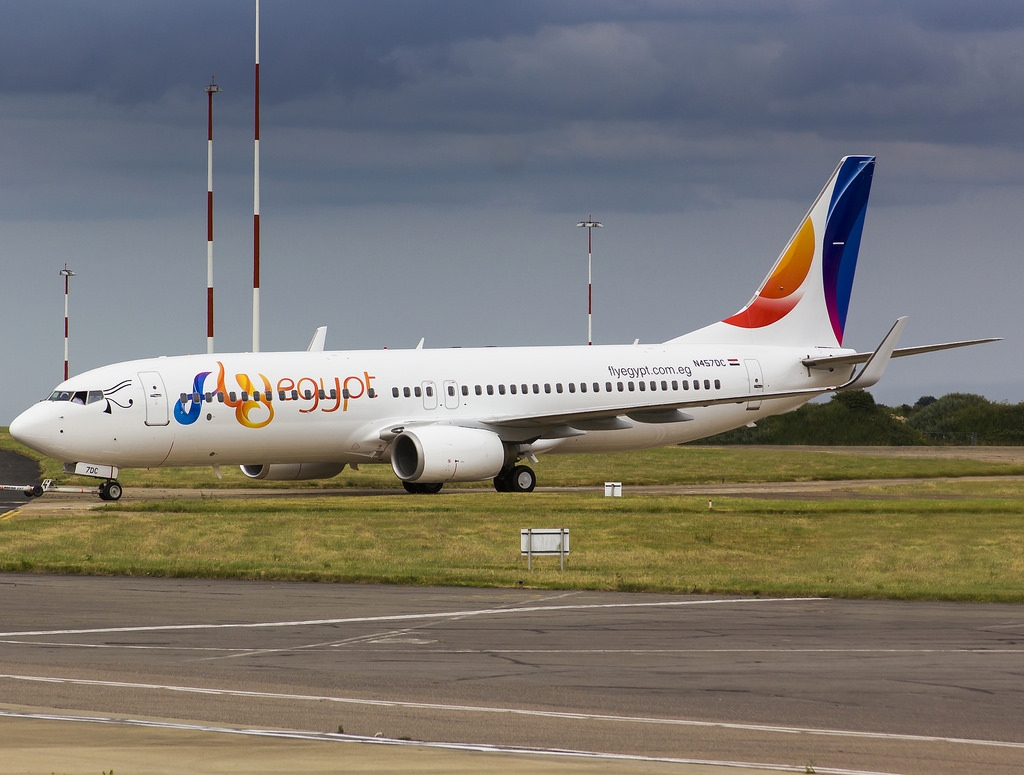
Alan Dron spoke to Ralf Nagel, who aims to blend German efficiency with Middle East hospitality as he switches FlyEgypt from a charter operator to a hybrid carrier.
Astonishingly, only 3% of tourists who fly to Egypt do so on board an Egyptian airliner. Captain Ralf Nagel, CEO of new Cairo-based carrier FlyEgypt, hopes to redress that imbalance, at least slightly. The airline began services in February and is initially concentrating on the inbound tourism market.
Charter operations will form FlyEgypt’s initial business, but within the next year it plans to become a hybrid carrier by also offering scheduled services.
“We need some stable ‘bread and butter’ business on a daily basis,” said Nagel. Initially, plans had been for a low- cost carrier (LCC), but this had been dropped in favour of simply operating as efficiently as possible, with companies such as Norwegian or Ryanair the role models.
FlyEgypt will use the workhorse Boeing 737-800 as its equipment: The first arrived in January, while the second was taken on strength in July.
“The first aircraft was bought from Airberlin. I convinced the owner to do this to demonstrate to the market that we were serious,” explained Nagel. The second was leased from Babcock & Brown and future aircraft will also be taken on lease.
“I want to reach a critical mass fleet of six to seven aircraft as quickly as possible. If we have 10, that will be wonderful,” he added.
Nagel stresses the need for a single-type fleet. For a small operator, having more than one type is fatal, he said.
However, he does not want the airline to increase in size too dramatically. He is happy to stay off the radar screen of larger airlines. FlyEgypt will initially operate from Cairo and Alexandria. EgyptAir is obviously a huge player at Cairo, but Nagel stressed that he had no wish to start competing with the national carrier.
FlyEgypt’s backers are members of the Talaat Mostafa Group, one of Egypt’s largest conglomerates, with interests in everything from construction to agriculture and hotels.
The idea for establishing an airline was born in 2010 but political unrest at that time led to the project being postponed. It was resurrected recently, with a philosophy of blending Egyptian hospitality with European efficiency.
Nagel, who had previously been with Airberlin for 16 years in a series of flying and management roles, was brought on board to head the project. He remains a qualified Boeing 737 pilot.
While the image of mixing Egyptian hospitality and European efficiency is a pleasant one, Nagel has found that the two cultures can sometimes clash. As a German dealing with Middle Eastern working practices, he admitted it could be difficult to convince his colleagues to follow his way of doing things.
His Egyptian colleagues were highly experienced, he said, but had become accustomed to operating in certain ways: “I’m strongly pushing them to educate themselves, to upgrade their experience.” He hopes to establish an exchange programme to bring in more international experience.
Although FlyEgypt has not been created as a LCC, Nagel is trying to replicate some of the standards to which European LCCs operate. Turnarounds at Airberlin take only 30 minutes, for example; his FlyEgypt colleagues initially said they could not handle even a 45-minute stop between sectors. “I said, ‘No, I’ll show you how to do it,’” said Nagel. “That simple example encapsulates the whole story.”
He is urging his colleagues to look at every area where efficiency can be improved. One problem, he said, was that Egyptian companies tended to have a large workforce of low-paid staff: “My management colleagues are used to working in huge organisations and to having lots of assistants. You have to have a lean and profitable structure.”
Adding more staff was not the answer to creating an efficient company and he had convinced senior management that it was better to pay more money to get the right staff.
FlyEgypt sees great potential in the European market. The Middle East is also promising, although there is considerable competition there. And much will depend on the political situation in the region settling down. Recent terrorist attacks in Egypt and Tunisia have had a chilling effect on reservations.
“Yes, there’s a risk, but there’s also huge potential,” said Nagel. “If we just grab the chance and do it better than the other airlines, we might have a success story on our hands.”