



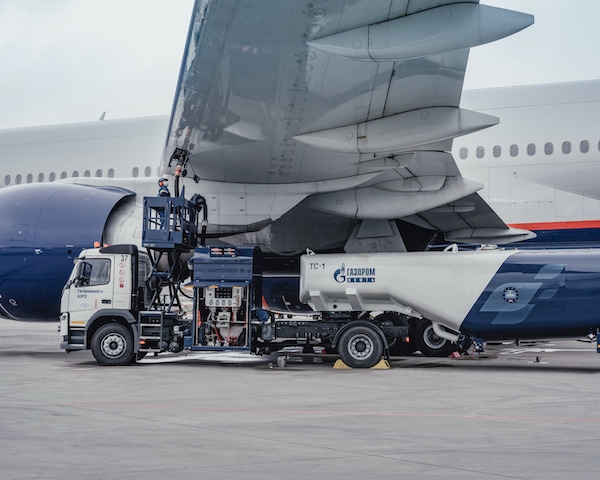
Gazprom Neft has entered into an agreement with Aeroflot on cooperating in producing Russia’s first ever minimum-carbon-footprint sustainable aviation fuel (SAF), under a document signed by Gazprom Neft CEO Alexander Dyukov and Aeroflot CEO Mikhail Poluboyarinov at this year’s Eastern Economic Forum.
This partnership between Gazprom Neft and Aeroflot envisages the companies developing effective aviation-fuel formulations fully compliant with international requirements on limiting greenhouse gas emissions and the International Civil Aviation Organisation’s (ICAO) CORSIA environmental programme.** The new aviation fuel will be adapted for use on various types of aircraft, and will be certified under Russian and international aviation safety standards. A working group on developing Russian SAF is also expected to include Russian and international aircraft manufacturers.

Gazprom Neft CEO Alexander Dyukov commented: "We can see that — in the light of the need to cut hydrocarbon intensity in air transportation — there is, potentially, considerable demand for ‘green’ fuel: from our own country’s aviation industry, and all around the world. Gazprom Neft’s technological and R&D competencies mean the company can get actively involved in developing a product of this kind. The key research facility for this will be Gazprom Neft’s Industrial Innovation Technology Centre in St Petersburg. And partnering with Russia’s leading airline can only make the process of developing a low-hydrocarbon-footprint aviation fuel even more efficient.”
Aeroflot CEO Mikhail Poluboyarinov said: “Ecology is fast becoming one of the most important issues in aviation — and the pandemic has only served to make this still more relevant. Environmental friendliness has always been front of mind for the Aeroflot Group. Upgrading the fleet and using modern airliners has made it possible for us to cut our carbon footprint by 30% over the last 10 years. The agreement signed with Gazprom Neft on developing sustainable aviation fuel marks a major step forward in improving environmental friendliness. Many international air carriers are starting to use SAF on a test basis, and plan to increase their proportional usage of this fuel over the next 10 to 20 years. We are happy to reaffirm our commitment to the environmental priorities of the aviation industry, but it is, at the same time, very important for the Aeroflot Group that using SAF makes sense not just environmentally, but economically, too.”

Azerbaijan Airlines (AZAL), part of AZCON Holding, has taken delivery of another Airbus A321neo, increasing its fleet to 31 aircraft as the carrier continues its long-term modernisation strategy. The...
For the fourth consecutive year, Corsair is reaffirming its commitment to the fight against breast cancer by partnering with the association "Les Hôtesses de l’Air cont...
Rising production rates and the launch of new aircraft programs are driving increased demand for manufacturing capacity across the aerospace industry. To support this growth, FACC plans to i...
FL Technics Indonesia, the first MRO in Indonesia to be appointed as a GE Aerospace avionics support partner, has signed a service support agreement with GE Aerospace covering Boeing 737 and Airbus A3...

