



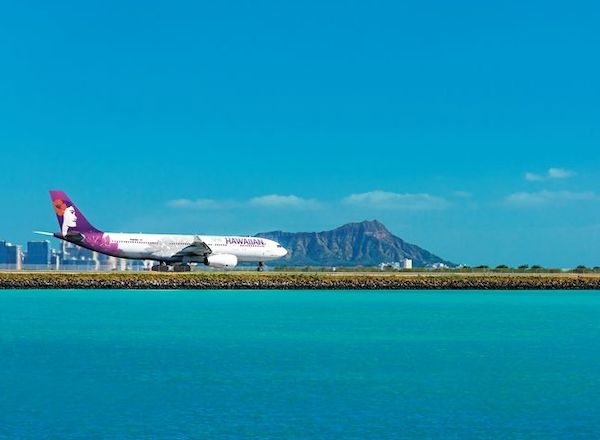
Hawaiian Airlines announced more details of its plan to achieve net-zero greenhouse gas (GHG) emissions by 2050, including commitments to significant progress in the 2030s. The carrier’s decarbonization roadmap relies on several key drivers, including the use of sustainable aviation fuel, fleet modernization and new aircraft technologies, operational best practices to improve fuel efficiency, and advocacy for air traffic control system improvements. Hawaiian anticipates that SAF – which is made from sustainable feedstock and can have a life-cycle carbon intensity 50-80% lower than conventional jet fuel – will be the biggest contributor to reduce jet fuel emissions, which constitute the vast majority of its GHG footprint.
Peter Ingram, president and CEO of Hawaiian Airlines, commented: “Becoming a net-zero carbon airline is a challenge, but as an airline serving the Pacific we recognize how critical it is that Hawaiian become a more sustainable company for our guests, employees and communities. We are excited about the progress we are making and these intermediate targets to which we are committing today.”
In addition to reaffirming its intention to achieve net-zero emissions by 2050, the carrier committed to:

Hawaiian last week announced it would purchase 50 million gallons of SAF from biofuel company Gevo Inc., with deliveries anticipated to begin in 2029. Hawaiʻi’s hometown airline has also partnered with Par Hawaii, the state’s largest provider of energy products, to study the commercial viability of SAF production in Hawaiʻi.
The production of SAF is a nascent industry that will have to scale significantly to meet the airline industry’s decarbonization goals. Hawaiian looks forward to continuing to collaborate with fuel producers, as well as states and the federal government, to help accelerate SAF production and availability at commercially viable prices.
Hawaiian, whose fleet of Airbus A330 and A321neos is among the most modern in the U.S. airline industry, has agreed to purchase 12 new Boeing 787-9 aircraft that are scheduled to begin arriving later this year. They feature advanced aerodynamics, modern engines and a composite airframe contributing to an approximately 20% fuel-efficiency improvement over prior-generation, similarly sized aircraft.
In addition to modernizing its fleet, Hawaiian is also engaged with airframe and aircraft engine manufacturers to explore new, low-carbon technologies. Hawaiian is an equity investor in REGENT, a company developing a battery-electric powered seaglider that could be suited for the carrier’s network of flights between the Hawaiian Islands.
Tecnam has announced a landmark strategic partnership aimed at accelerating the growth of its P2012 aircraft family across the United States. Under the agreement, Finnoff has been appointed the exclus...
The International Aircraft Dealers Association (IADA) has released its 2026-2027 Current Market Portrait & Forecast, offering an in-depth analysis of the global preowned business av...
FL Technics Indonesia, the first MRO in Indonesia to be appointed as a GE Aerospace avionics support partner, has signed a service support agreement with GE Aerospace covering Boeing 737 and Airbus A3...
flyadeal, the fast-growing low-cost carrier of Saudia Group and one of the GCC's largest budget airlines, has expanded its presence in India with the launch of non-stop flights between Riyadh and...

