



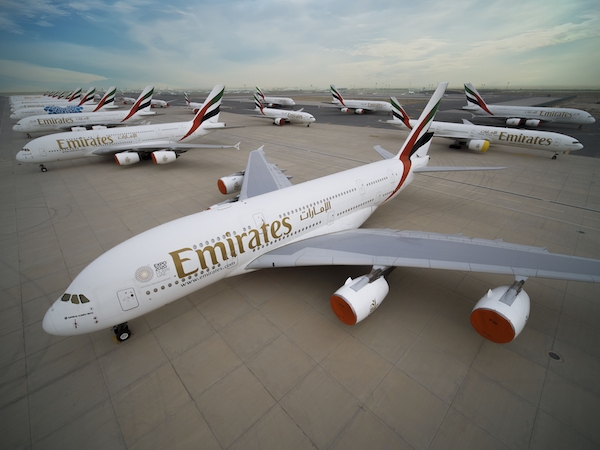
While the world yearns to travel once again, meet and hug loved ones, seek new adventures and close those business deals, Emirates is busy protecting and readying the world’s largest all wide-body fleet to take to the skies. This could have proved daunting, but Emirates Engineering, a division of the airline and one of the world’s most technologically advanced aircraft maintenance facilities, has it all covered – literally!
Ahmed Safa, Emirates’ Divisional Senior Vice President Engineering said: “Emirates moves to a different drumbeat – one where the highest standards are absolutely fundamental to our entire organisational rhythm. Everything we do ladders up to ensuring the best customer experience and people feeling safe and reassured while flying with us.
“That philosophy also extends to our Engineering team and how we maintain and secure our multibillion dollar fleet with the world’s largest number of Airbus A380s and Boeing 777s. We don’t just cover our engines, but have a comprehensive aircraft parking and reactivation programme that strictly follows manufacturers’ guidelines and maintenance manuals, and we have enhanced standards and protocols of our own.
“We also have the enviable challenge of a full wide-body fleet – 115 A380s and 155 B777s – and the most sophisticated systems and avionics in the industry. While a narrow-body aircraft only requires around 3-4 employees working for eight hours or so to cover it, our aircraft need 4-6 employees working a 12-hour shift. And taking extra precautions while maintaining social distancing adds its own interesting twist to the proceedings.”
The parked fleet
Of the 270 aircraft in its fleet, Emirates had initially parked and wrapped up 218 aircraft – 117 at Dubai World Central and 101 at Dubai International airport – that involved more than 15,500 man-hours of work.
Now around 75 Emirates aircraft, both passenger and freighter, are crisscrossing the planet carrying people on repatriation and cargo on essential missions. These continue to be maintained as per standard operating procedures. Some aircraft are undergoing scheduled heavy maintenance in Emirates Engineering’s hangars.
It’s been done before
Routinely, Emirates covers all aircraft that are taken out of operations for more than 48 hours. Much before the pandemic, Emirates has had to cover a significant part of its fleet during the runway closures at Dubai International airport, and even during the 2010 volcanic ash cloud disaster that partially grounded the fleet.
Securing the fleet and ultra-sensitive avionics systems
All apertures and openings through which environmental factors – sand, dirt, water, birds and insects – can find their way inside an aircraft are wrapped up and made watertight. That includes engines and air data probes – such as pitot, static, temperature, angle of attack sensors – engine intakes and exhausts, and APU intakes and exhausts.
The interiors – whether cabin monuments, seats or inflight entertainment equipment – are also protected from the elements. Potable water systems and aircraft fuel tanks are preserved, and engine and APU systems are protected. The process also involves the greasing, cleaning and preservation of landing gear and flight control systems. The team turns off all cockpit switches, disconnects batteries, and installs control lever locks and window blinds.
Routine checks
After concluding the protection and preservation works, the team completes periodic checks at 7-, 15- and 30-day intervals across the fleet. These can include simple walk-around inspections to ensure all covers are in place, and there are no visible damages or external leaks. Complex checks include removing the covers and reactivating aircraft systems, idling engines and testing engine bleed air and flight control systems.
Reactivating the fleet
Ahmed Safa said: “We need around 4-5 dedicated employees and at least 18-24 hours to put one of our aircraft back into service. Our customers and our employees can’t wait to see our majestic A380s and our powerful 777s grace the skies again, operating our normal schedules and delighting travellers worldwide.”
Cirrus Aircraft has broken ground on a new 15,000-square-foot Engine Run-Up Center that will centralize engine testing, fuel calibration and certification activities for the SR Series, Vision Jet and...
Few infrastructure projects have the potential to reshape an island's future quite like the ongoing transformation of Nevis Airport. To gain deeper insight into this ambitious development and the...
Asco, a subsidiary of Montana Aerospace AG, achieves significant technological milestone in the development of a hybrid multi-material Rear Secondary Structure for Airbus. Montana Aerospace,...
The U.S. Federal Aviation Administration has certified the Boeing 737-10, the newest and largest member of the 737 MAX family, paving the way for Boeing [NYSE: BA] to begin customer deliveri...

