



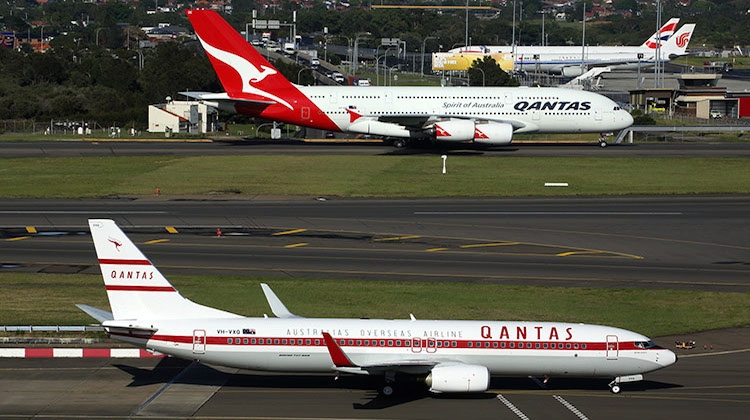
Qantas’s shares have tumbled sharply after the airline group announced putting a brake on domestic growth in response to weaker-than-expected demand.
On the domestic front, Qantas said it would cut capacity in the three months to June 30 2016, compared with the prior corresponding period, in response to the airline posting negative revenue per available seat kilometre (RASK – an industry measure of demand) in March and weaker-than-expected traffic over the Easter and school holiday period in most Australian states.
As a result, previously forecast capacity growth for the combined Qantas/Jetstar domestic network of about two per cent in the second half of 2015/16 has been revised downwards to growth of between half a per cent and one per cent, Qantas said.
“In response to changed demand conditions, the Qantas Group has revised planned capacity additions in the final three months of financial year 2016,” Qantas said in its monthly traffic and capacity figures for March released on Monday.
“Some softness in demand, related to the upcoming federal election and recent drop in consumer confidence in Australia, began to emerge over the peak Easter and school holiday period in late March and continued to be seen in forward bookings in April and May.
“Traffic over the peak Easter and school holiday period from late March fell below expectations, compounded by a disconnect in the timing of Easter and school holidays in most Australian states.
The March traffic figures showed Qantas’s domestic network’s available seat kilometres (ASK) were flat in the month, while passenger numbers rose 1.2 per cent.
At 1200 AEST, Qantas shares were down 54 cents, or 13.3 per cent, at $3.50 on the Australian Securities Exchange. This compared with a two per cent gain on the broader market. Virgin Australia shares were flat at 35.5 cents.
The Flying Kangaroo’s international services suffered a 2.9 percentage point decline in load factors to 78.6 per cent in March, with passenger demand not able to keep up with the 8.2 percentage point boost to ASKs.
On the international front, Qantas noted on Monday three Sydney-Los Angeles rotations – the evening departure QF17 from Sydney and reciprocal QF18 from LA – would be cut from April 26. The reduction to a daily service, from 10 times a week currently, was first announced in November 2015.
The aircraft will be re-deployed to Singapore and Hong Kong in response to demand in those markets. Qantas said in March it would offer 13 or 14 flights a week on the Sydney-Hong Kong route during the “Northern Summer” scheduling season, up from 11 flights a week currently, with the expanded frequency beginning on April 4 and running until to October.
Further, Qantas planned to lift its Melbourne-Singapore offering to 10 times weekly from the end of April, while some Melbourne-Hong Kong flights are being upgauged to Boeing 747-400s, from Airbus A330s.
The trans-Pacific market has been particularly active in recent times, with the arrival of American Airlines on the Australia-US route, in cooperation with Qantas, as well as Air New Zealand starting Auckland-Houston services, in December. Qantas also resumed flights to San Francisco just before Christmas.
And there is more new capacity to come with American launching Auckland-Los Angeles and United returning to NZ with Auckland-San Francisco services in June and July, respectively.
As a result, airlines have been offering heavy discounts to fill their flights – travel websites have reported US-New Zealand itineraries, including some via Australia, were being offered for as low as $US225 return in April.
There have also been sales for US-Australia flights for less than $US400.
And from this side of the Pacific, there are sale fares currently in the market for Australia to the US – either one-stop of nonstop – for less than $A1000 return.
Qantas said these changes would result in total market seat capacity growth between Australia and the US of six per cent, compared with a projected nine per cent growth prior to these changes being made.
At Jetstar, domestic ASKs grew 9.6 per cent, while there was a 9.3 per cent increase in passengers carried. However, the low-cost carrier also found things a little more difficult on the international front, with load factors easing 1.9 percentage points to 78.1 per cent as ASK grew 17.2 per cent compared with revenue passenger kilometres (RPK) increasing 14.4 per cent.
“Jetstar International RASK was negative as it continued to grow into recent capacity additions and due to softer demand on services to Honolulu,” Qantas said.
“Qantas International RASK decreased, reflecting more competitive pricing on routes including the UK and US, while new services to Asia continued to perform in line with expectations.”
Jetstar is reducing its presence in Hawaii from late October, when it exits Brisbane-Honolulu, leaving Hawaiian Airlines as the only operator on the route.
British Airways has unveiled the next phase of its Heathrow lounge transformation programme, marking the beginning of a significant investment aimed at modernising every lounge across the airport in t...
flyadeal, the fast-growing low-cost carrier of Saudia Group and one of the GCC's largest budget airlines, has expanded its presence in India with the launch of non-stop flights between Riyadh and...
Tecnam has announced a landmark strategic partnership aimed at accelerating the growth of its P2012 aircraft family across the United States. Under the agreement, Finnoff has been appointed the exclus...
Dutch flag carrier KLM, part of the Air France-KLM Group, has welcomed its first Airbus A350-900, marking a significant step in the airline’s long-haul fleet modernization strategy. The arrival...

