



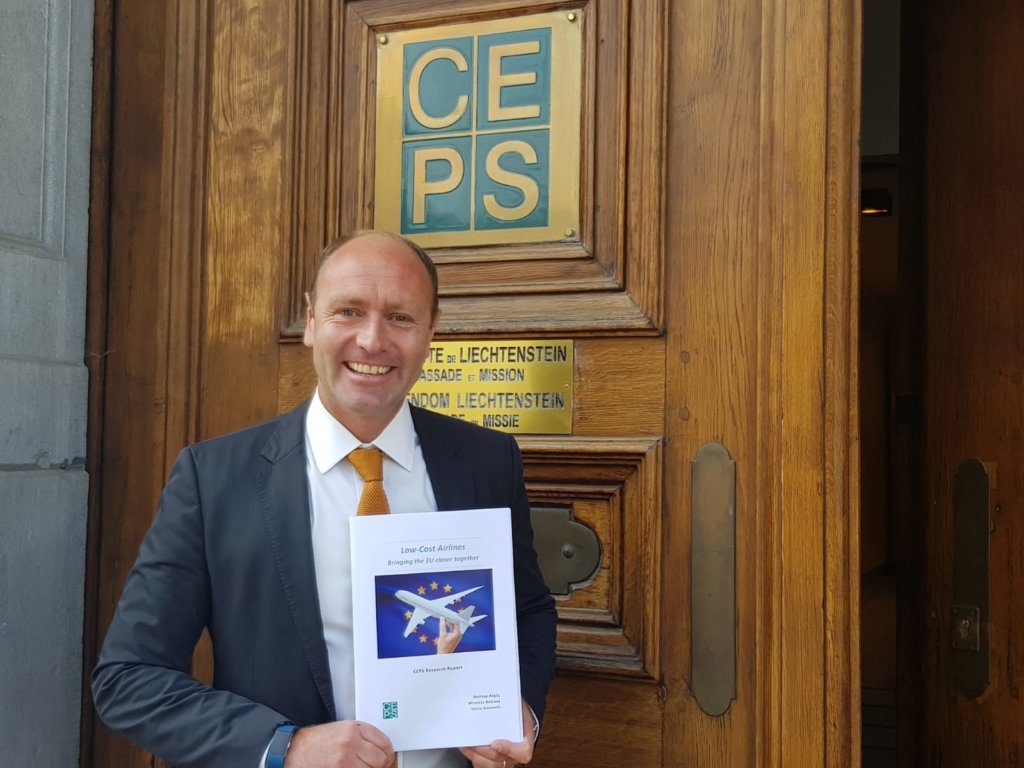
Ryanair, Europe’s No.1 airline, welcomed the findings of a research project carried out by CEPS (Centre for European Policy Studies) exploring the impact of low-cost carriers in Europe in terms of integration and patterns of mobility.
The report, titled ‘Low-Cost Airlines: Bringing the EU Closer Together’*, considered several channels to assess the extent of the contribution of low-cost carriers like Ryanair to European integration including labour and student mobility, business travel and leisure tourism. Focusing on quantitative data as well as qualitative, individual case studies, the report served to highlight how low-cost connectivity improves the quality of people’s lives. The report found that LCCs played a vital role in bringing Europe closer together by fostering mobility and making air travel affordable to a wider public.
Low-cost airlines – led by Ryanair – have revolutionised air travel over the past 30 years. By challenging the high-fare monopoly legacy carriers in Europe, Ryanair and other low-cost airlines have done more for European integration through travel, tourism and labour mobility, than perhaps any institution.
This year, Ryanair will
• Carry 138m customers on over 1,800 different routes
• Serve 216 airports in 37 different countries,
• Support local economies and regional development of less travelled regions
• Support over 103,000 ancillary jobs* throughout Europe
• Help Erasmus students save more on their travel – over €3.3m saved since August 2017
• Continue to stimulate labour mobility and business travel through Ryanair Flexi Plus
While Ryanair will continue to offer the lowest fares and widest selection of routes, the airline called on the EU to tackle key aviation issues – including travel taxes, ongoing and unjustified ATC strikes, lack of competition and artificial capacity constraints – that continue to be prohibit further growth in the industry.
Launching the report in Brussels, Ryanair’s Kenny Jacobs said:
“Ryanair welcome the findings of this CEPS report, the objective of which was to understand to what extent low-cost airlines have contributed as well as can contribute to European integration. As confirmed by this report, low fares have helped to create a new and growing market for people who would have never travelled before. This is connecting and integrating Europe and at the same time creating employment opportunities and increasing tourism expenditure.”
ENDS
*‘Low-Cost Airlines: Bringing the EU Closer Together’ is available here
**ACI research confirms up to 750 ‘on-site’ jobs are sustained at international airports for every 1m passengers
Emirates has officially inaugurated services to Helsinki, marking a significant milestone in connectivity between Finland and the United Arab Emirates. The new daily route is the only year-r...
For the fourth consecutive year, Corsair is reaffirming its commitment to the fight against breast cancer by partnering with the association "Les Hôtesses de l’Air cont...
TRU Simulation + Training Inc. will showcase its Veris Virtual Reality Flight Training Device (FTD) for the Cessna Skyhawk at NBAA-BACE 2026, marking the simulator's first appearance at the indust...
FL Technics Indonesia, the first MRO in Indonesia to be appointed as a GE Aerospace avionics support partner, has signed a service support agreement with GE Aerospace covering Boeing 737 and Airbus A3...

