



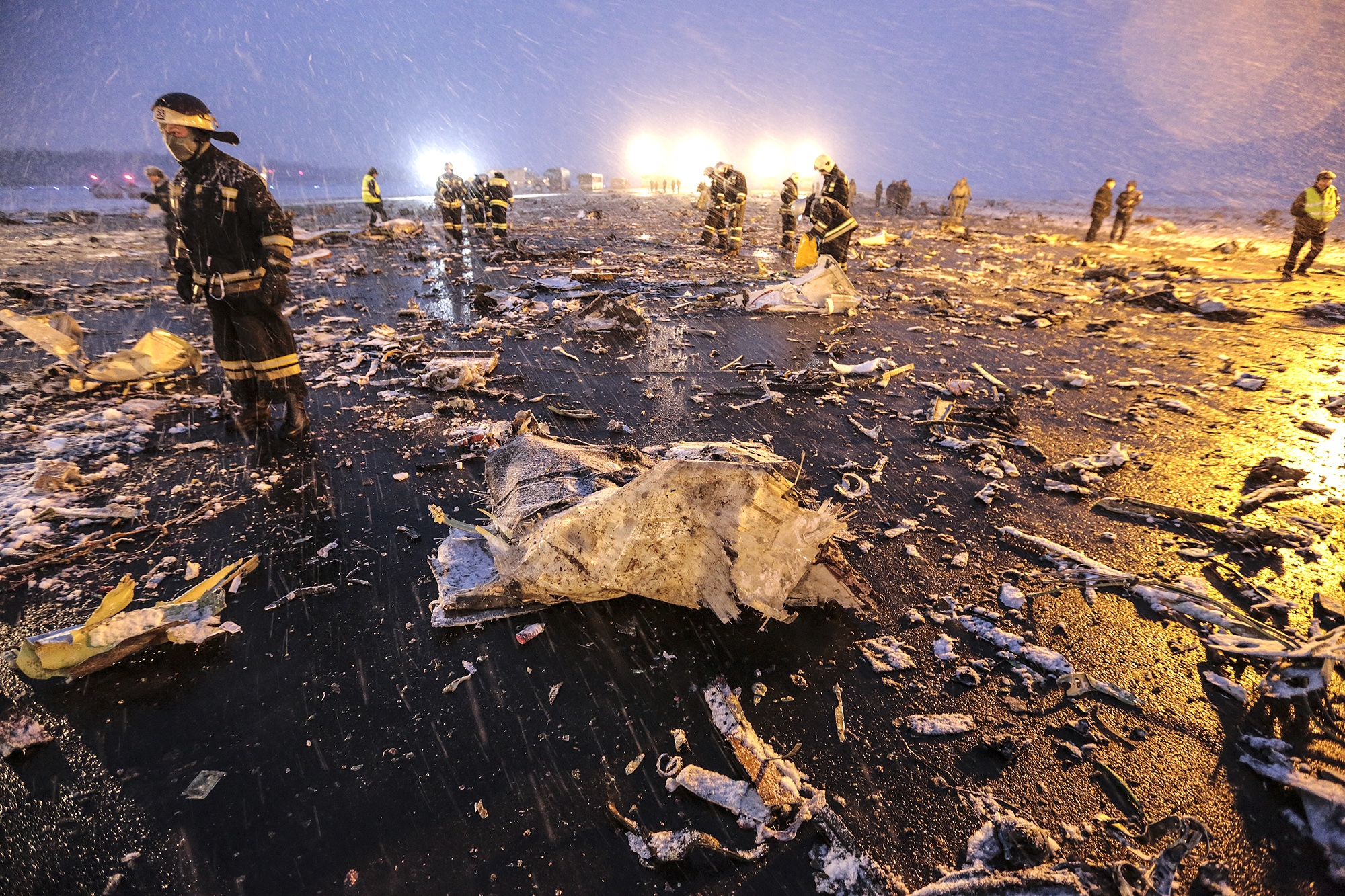

The Russian Interstate Aviation Committee published an interim report, detailing the progress of their investigation into the cause of the fatal accident involving the flydubai Boeing 737-800 at Rostov Airport on March 19.
The aircraft operated on flight FZ981 from Dubai to Rostov. The flight to Rostov was unevenful. At 22:42 UTC (01:42 local time) in the course of the initial approach at a height of 340 meters (1115 feet), the flight received a windshear alert. The flight crew decided to go around and then continued to a holding pattern waiting for improved weather conditions.
The flight left the holding pattern at 00:28 UTC (03:28 LT) and descended towards Rostov for another attempted approach to runway 22.
As the crew were proceeding with another manual approach, they decided to go around again at a height of 220 meters (721 feet), 4,5 km before the runway. They initiated a climb with a vertical speed of up to 20 m/s (3937 ft/min) and setting the engines to maximum takeoff/go-around (TOGA) thrust.
One of the probable causes of the go-around decision could have been the 20-knot increase of indicated speed to as much as 176 knots within 3 seconds, which might have been an indication of a windshear.
In the course of the go-around the crew set the flaps to 15° and retracted the landing gear. At the height of 1900 ft (approx. 600 m) after reaching the pitch angle of 18° the pilot flying pushed on the control column, which led to a decrease in vertical acceleration of up to 0.5, increase in forward speed and, consequently, automatic retraction of flaps from 15° to 10° at a speed of over 200 knots.
The short-term decrease in engine thrust within 3 seconds resulted in decreasing speed and flaps extension to 15°, although the following crew inputs to regain maximum takeoff/go-around thrust led to speed increase and reiterated automatic flaps retraction to 10°. The flaps remained in the latter configuration until the impact.
The pilot flying, by pulling up the control column, continued climbing with a vertical speed of as much as 16 m/s (3150 ft/m).
At a height of 900 m there was a simultaneous control column nose down input and stabilizer nose down deflection from -2,5 deg (6,5 units) to +2,5 deg (1,5 units). The FDR recorded a nose down stabilizer input from the stabilizer trim switch of the control wheel lasting 12 seconds, while the CVR record contains a specific noise of rotation of the trim wheels located on both sides of the central pedestal. As a result the aircraft, having climbed to about 1000 m, turned into descent with a negative vertical acceleration of -1g. The following crew recovery actions did not allow to avoid an impact with the ground.
The aircraft hit the runway about 120 m from the threshold with a speed of over 600 km/h and over 50 degrees nose down pitch.
IAC recommends among others to give pilots additional training on elements of go-arounds in various conditions, in manual control mode with two engines operative from various heights and with insignificant flight weights.
|
|
|
TRU Simulation + Training Inc. will showcase its Veris Virtual Reality Flight Training Device (FTD) for the Cessna Skyhawk at NBAA-BACE 2026, marking the simulator's first appearance at the indust...
Rising production rates and the launch of new aircraft programs are driving increased demand for manufacturing capacity across the aerospace industry. To support this growth, FACC plans to i...
UH-60 Black Hawk helicopters operated by Helicopter Alliance played a vital role in combating wildfires across Central and Southern Europe during the aerial firefighting season that has now concluded....
Etihad Airways has signed an interline agreement with Nigerian airline Ibom Air, enabling travellers to connect seamlessly beyond Lagos and Accra to five destinations across Nigeria on a single t...



