



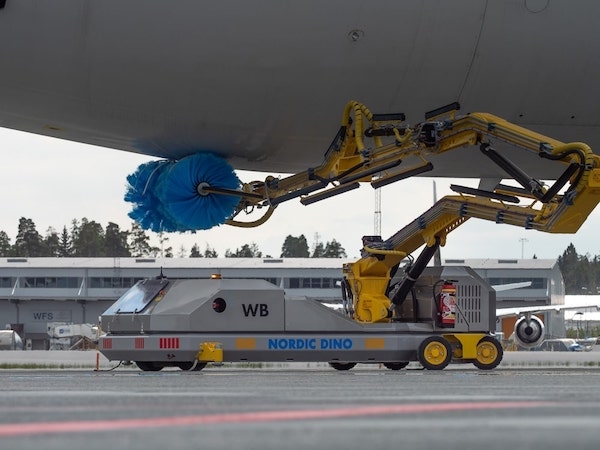
With the onset of winter and plummeting temperatures, the importance of aircraft de-icing and washing can never be overstated. As temperatures drop below zero, snow and ice can accumulate on an aircraft’s wings, engine cowlings, and fuselage, all of which can lead to a negative impact on the aircraft’s performance and safety. Jan Brunstedt, the CEO of Aviator Robotics AB shared some insights into the importance of both critical processes.
According to the CEO, as winter takes a stronger hold, many aircraft – especially in the Nordic countries – may need to undergo the de-icing process 4 to 5 times per day to negate any safety issues caused by sub-zero temperatures. In such conditions ice can accumulate on the leading edges of wings which can, in turn, disrupt the smooth flow of air over the wings; the fundamental process that produces lift in an aircraft. Additionally, when the aircraft’s engine powers up, ice that has gathered on the wings can become dislodged through vibrations and enter the engine, with what could be disastrous consequences.
The accumulation of ice on the aircraft can add additional weight – for example; ice on an A320 can add as much as 175kg to its overall weight, extending the length of runway required for a successful take-off.
To remove any accumulated ice, aircraft are sprayed with de-icing agents while on the ground, using either propylene glycol (PG) or ethylene glycol (EG). The use of PG is more common in Europe – although it is more expensive – due to its hugely reduced impact on the environment in comparison to EG.
Once de-icing or anti-icing agents have been applied, and aircraft usually has 15-20 minutes Holdover Time (HOT) between application and take off; after this time there is a danger that ice may begin to reform. With the use of EG – a more viscous agent similar to a gel – an additional 10 to 15 minutes can be added to the HOT. However, the use of EG, despite being a less expensive solution, is seen as being more harmful to the environment.
As runways are also subject to de-icing, aircraft need to be washed more regularly to prevent a build of harmful materials - which can be ‘kicked up’ during take-off – in the aircraft’s flaps and landing gear. Regular washing – especially of the aircraft’s belly section – also helps to prevent any corrosion of the aircraft’s painted surfaces, while a clean aircraft makes for the early identification of metal corrosion or paint damage. This quick identification can save time and expenditure, and help in the prevention of any future lengthy maintenance procedures.
Finally, a clean aircraft gives a positive first impression of an airline’s status, and may even help in driving customers to choose one airline over another. A clean aircraft can be the impetus that lays the foundations for a client’s trust.
According to Jan Brunstedt, the CEO of Aviator Robotics AB, the developers of the advanced Nordic Dino robotic aircraft washing system, “Both de-icing and aircraft washing are of paramount importance to airlines and aircraft owners. The need for both processes increases dramatically in wintertime and should never be taken for granted. Excessive icing on aircraft has been responsible for many avoidable tragedies in the past, however, thanks to new de-icing procedures and materials, along with the introduction of advanced technologies, like Nordic Dino’s robotic washer, aircraft safety in extreme conditions has been improved dramatically, while offering the benefits of saving time and reducing unforeseen maintenance expenses.”
Tecnam has announced a landmark strategic partnership aimed at accelerating the growth of its P2012 aircraft family across the United States. Under the agreement, Finnoff has been appointed the exclus...
Emirates has officially inaugurated services to Helsinki, marking a significant milestone in connectivity between Finland and the United Arab Emirates. The new daily route is the only year-r...
PAL-V has signed a Memorandum of Understanding with AVION, a specialist in advanced flight training devices, and FLYVE, a developer of FlyDrive ecosystems for professional and government operator...
In a landmark step towards next-generation regional aircraft manufacturing, Jungheinrich has delivered an advanced automated logistics centre to Deutsche Aircraft at Leipzig/Halle Airport. Supporting...

