



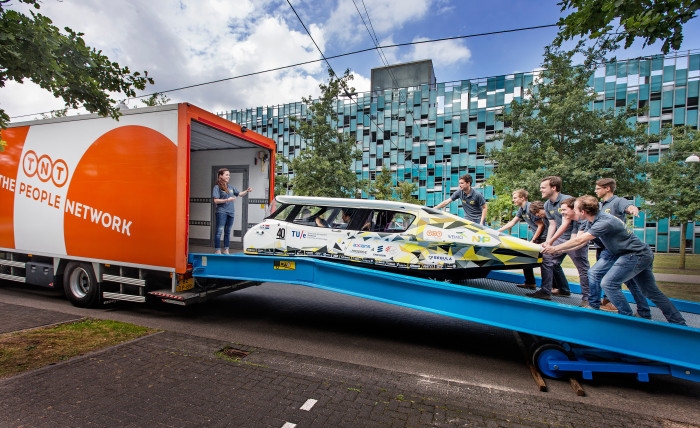
TNT has transported a prototype solar car from the Netherlands to Australia for the World Solar Challenge between 18 and 25 October.
The car, called Stella Lux, built by students at Eindhoven University of Technology, was transported by road from Eindhoven (the Netherlands) to Liege (Belgium), before flying to Singapore then Melbourne (Australia). The lithium batteries were sent by boat due to not having ready made documentation but TNT say the car and batteries arrived within a week of each other.
TNT Benelux managing director, Erik Uljee says: “We are happy to support Solar Team Eindhoven, a great team of student engineers, in winning the World Solar Challenge for the second time. Automotive is a priority industry sector for TNT and we’re glad to support research and innovation to make road transport safer and sustainable.”
Stella Lux is a wedged shaped electric car which charges itself with solar cells on its roof. The students claim the car can travel 1,000 kilometres (621 miles) on a single charge and has a top speed of 77 miles per hour. it has a navigation system to provide route guidance based on weather predictions. The race will cover 3,000 kilometres between the Australian cities of Darwin and Adelaide.
Avelo Airlines reached a major milestone, flying its 10 millionth Customer just five years after redefining affordable air travel in as America's most convenient airline. Since launching on April...
U.S. Federal Aviation Administration has granted Boeing an amended type certificate for the new 737-7 airplane, clearing it for commercial service. The smallest...
Archer Aviation completed a piloted roundtrip journey with its all-electric Midnight aircraft on July 30th, departing from Salinas Municipal Airport and landing at Monterey Regional Airport...
Air France-KLM today has submitted a binding offer to Parpública for the acquisition of a 44.9% to 49.9% stake in TAP Air Portugal, marking a decisive step in the airli...

