

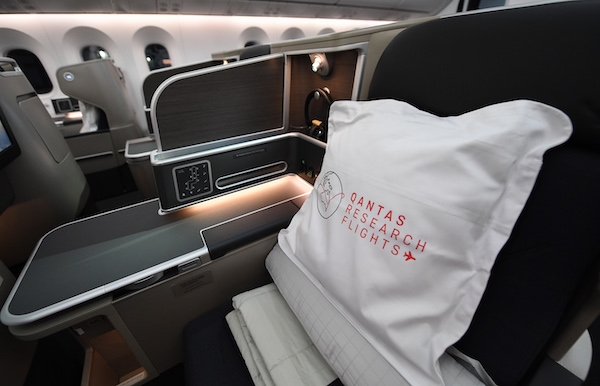
The first non-stop commercial airline flight from New York to Sydney has landed after 19 hours 16 minutes in the air.
A total of 49 passengers and crew were on the flight, which was used to run a series of experiments to assess health and well-being onboard. Data from these experiments will be used help shape the crew rostering and customer service of Qantas’ ultra long haul flights in future – including Project Sunrise (opens in new window).
Tests ranged from monitoring pilot brain waves, melatonin levels and alertness, through to exercise classes for passengers.
Cabin lighting and in-flight meals were also adjusted in ways that are expected to help reduce jetlag, according to the medical researchers and scientists (opens in new window) who have partnered with Qantas.

Arriving in Sydney, Qantas Group CEO Alan Joyce said: “This is a really significant first for aviation. Hopefully, it’s a preview of a regular service that will speed up how people travel from one side of the globe to the other.
“We know ultra long haul flights pose some extra challenges but that’s been true every time technology has allowed us to fly further. The research we’re doing should give us better strategies for improving comfort and wellbeing along the way.
“Night flights usually start with dinner and then lights off. For this flight, we started with lunch and kept the lights on for the first six hours, to match the time of day at our destination. It means you start reducing the jetlag straight away.
“What’s already clear is how much time you can save. Our regular, one-stop New York to Sydney service (QF12) took off three hours before our direct flight but we arrived a few minutes ahead of it, meaning we saved a significant amount of total travel time by not having to stop,” added Mr Joyce.

Qantas Captain Sean Golding, who led the four pilots operating the service, said: “The flight went really smoothly. Headwinds picked up overnight, which slowed us down to start with, but that was part of our scenario planning. Given how long we were airborne, we were able to keep optimising the flight path to make the best of the conditions.
“We had a lot of interest from air traffic controllers as we crossed through different airspace because of the uniqueness of this flight. We also had a special sign off and welcome home from the control towers in New York and Sydney, which you don’t get every day.

“Overall, we’re really happy with how the flight went and it’s great have some of the data we need to help assess turning this into a regular service,” said Captain Golding.
Two more research flights are planned as part of the Project Sunrise evaluations – London to Sydney in November and another New York to Sydney in December. Emissions from all research flights will be fully offset.
A decision on Project Sunrise is expected by the end of the year.

Photos by James D Morgan/Qantas.
Confidence among the world’s leading accredited aircraft dealers strengthened in the third quarter of 2026, reflecting continued momentum in the preowned business aviation market. According to t...
Air Baltic Corporation AS , Latvia’s national airline and the leading carrier in the Baltic States, announced that airBaltic and its subsidiaries participating in the voluntary Ch...
Electra has successfully completed the takeoff and landing of its hybrid-electric Ultra Short aircraft at Downtown Skyport in Lower Manhattan, in what is believed to be the first time a fixed-wing air...
Cirrus Aircraft has broken ground on a new 15,000-square-foot Engine Run-Up Center that will centralize engine testing, fuel calibration and certification activities for the SR Series, Vision Jet and...