



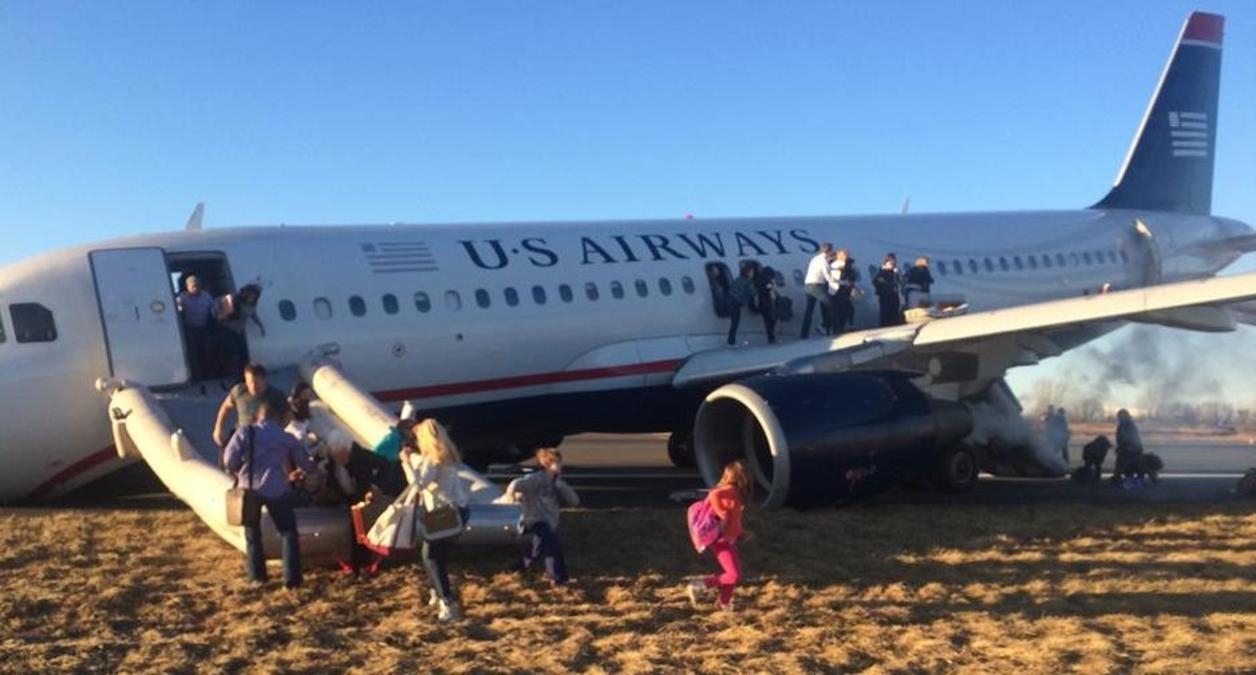
An aborted takeoff last year on a US Airways plane in Philadelphia, which smashed down so hard it broke the landing gear, was triggered by the crew's failure to enter the proper runway into a flight computer, among other errors, according to a preliminary investigation.
"What did you do?" the captain told the copilot as the Airbus Group SE A320 carrying 154 people raced down the runway and its computers failed to display the lift-off speed. "You didn't load. We lost everything." His words were captured by the plane's cockpit voice recorder.
A U.S. National Transportation Safety Board probe found that similar mistakes had prompted other pilots to break off takeoffs in the past at the carrier, now part of American Airlines Group Inc., and at least two written warnings had been issued to flight crews before the accident.
The NTSB probe comes as the safety board and the U.S. Federal Aviation Administration, which regulates airlines, have increasingly expressed concern that accidents have occurred because pilots didn't understand what highly automated aircraft computers were doing.
Warnings Blared
None of the people aboard the flight to Fort Lauderdale, Florida, were hurt, according to NTSB.
After discovering they had entered the wrong runway on March 13, 2014, the crew in Philadelphia decided to take off anyway as warnings blared in the cockpit, according to NTSB. Moments later, the captain abruptly reversed course and tried to stop the plane at a higher speed than was allowed after it had already lifted off, according to records released by the safety board.
The NTSB hasn't concluded the accident's cause. The new information on the crash is contained in preliminary reports summarizing factual information gathered in the investigation.
In June 2013, the airline had notified its pilots about "a number" of similar aborted takeoffs. A review of flight records after the 2014 accident showed there may have been several other such incidents that year, though the airline couldn't be sure, according to NTSB.
"American continues to support the NTSB investigation regarding this event," company spokesman Matt Miller said. "We cannot comment on possible findings or probable cause while the investigation is ongoing."
The Allied Pilots Association, a union representing the carrier's pilots, declined to comment because it's participating in the investigation, spokesman Captain Dennis Tajer said.
200 MPH
The twin-engine jet briefly lifted off and reached a speed of more than 200 miles (322 kilometers) an hour before the captain put it down and tried to stop, according to NTSB data.
The crew had earlier calculated they shouldn't attempt to stop on the runway at a speed higher than 181 miles an hour, a routine measure designed to prevent going off the runway or damaging the plane, according to NTSB. Pilots are taught it's best to lift off at higher speeds, even in emergencies.
The plane's tail struck the runway first and then its nose slammed down so hard the front landing gear collapsed. The passengers were evacuated after the plane came to rest and the pilots smelled smoke.
The captain told investigators he aborted the takeoff because he "felt like the airplane was totally unsafe to fly," the NTSB said in one of its reports.
Data Entry
The confusion during takeoff was triggered initially by the failure of the copilot to enter the proper runway into the plane's computers, according to NTSB. Both pilots were supposed to check the information but failed to notice the mistake. The pilots discovered it minutes before entering the runway, but failed to reenter critical information on temperature and expected takeoff speeds.
The reports didn't address how often similar mistakes are made at other airlines.
The captain told investigators he had never heard those type of warnings before on takeoff.
As part of the investigation, the NTSB also found that the crew hadn't given one of their engines sufficient time to warm up. In addition, the captain, 61, who had had a cardiac procedure in which he was sedated two days before the accident, didn't announce he was stopping the takeoff as required by the airline's flight manuals, according to the NTSB.
Since the accident, American has issued bulletins to air crews on how to handle the failure to enter proper information into flight computers.
TRU Simulation + Training Inc. will showcase its Veris Virtual Reality Flight Training Device (FTD) for the Cessna Skyhawk at NBAA-BACE 2026, marking the simulator's first appearance at the indust...
Rising production rates and the launch of new aircraft programs are driving increased demand for manufacturing capacity across the aerospace industry. To support this growth, FACC plans to i...
Emirates has officially inaugurated services to Helsinki, marking a significant milestone in connectivity between Finland and the United Arab Emirates. The new daily route is the only year-r...
PAL-V has signed a Memorandum of Understanding with AVION, a specialist in advanced flight training devices, and FLYVE, a developer of FlyDrive ecosystems for professional and government operator...

