



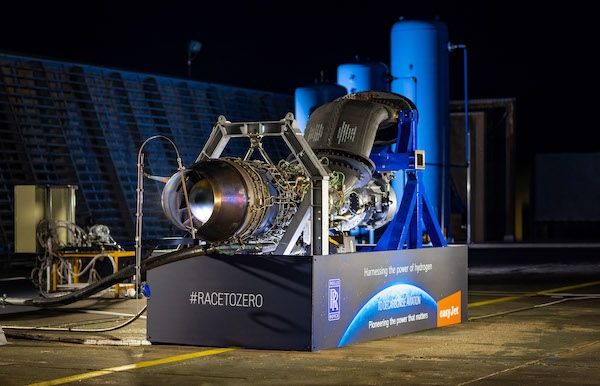
Rolls-Royce and easyJet have set a new aviation milestone with the world’s first run of a modern aero engine on hydrogen. The ground test was conducted on an early concept demonstrator using green hydrogen created by wind and tidal power. It marks a major step towards proving that hydrogen could be a zero carbon aviation fuel of the future and is a key proof point in the decarbonisation strategies of both Rolls-Royce and easyJet. Both companies have set out to prove that hydrogen can safely and efficiently deliver power for civil aero engines and are already planning a second set of tests, with a longer-term ambition to carry out flight tests.
The test took place at an outdoor test facility at MoD Boscombe Down, UK, using a converted Rolls-Royce AE 2100-A regional aircraft engine. Green hydrogen for the tests was supplied by EMEC (European Marine Energy Centre), generated using renewable energy at their hydrogen production and tidal test facility on Eday in the Orkney Islands, UK.
Secretary of State for Business, Energy and Industrial Strategy, Grant Shapps, commented: “The UK is leading the global shift to guilt-free flying, and today’s test by Rolls-Royce and easyJet is an exciting demonstration of how business innovation can transform the way we live our lives. This is a true British success story, with the hydrogen being used to power the jet engine today produced using tidal and wind energy from the Orkney Islands of Scotland – and is a prime example of how we can work together to make aviation cleaner while driving jobs across the country.”
Grazia Vittadini, Chief Technology Officer, Rolls-Royce, said: “The success of this hydrogen test is an exciting milestone. We only announced our partnership with easyJet in July and we are already off to an incredible start with this landmark achievement. We are pushing the boundaries to discover the zero carbon possibilities of hydrogen, which could help reshape the future of flight.”
Johan Lundgren, CEO of easyJet, said: “This is a real success for our partnership team. We are committed to continuing to support this ground-breaking research because hydrogen offers great possibilities for a range of aircraft, including easyJet-sized aircraft. That will be a huge step forward in meeting the challenge of net zero by 2050.”
Following analysis of this early concept ground test, the partnership plans a series of further rig tests leading up to a full-scale ground test of a Rolls-Royce Pearl 15 jet engine. The partnership is inspired by the global, UN-backed Race to Zero campaign that both companies have signed up to, committing to achieve net zero carbon emissions by 2050.

A professional training device such as the new PC-12 PRO simulator is built on flight data supplied and validated by Pilatus. Drawing on actual flight-test and performance data, it accurately reproduc...
Bombardier marked the 40th anniversary of its industry-leading Smart Services cost-per-flight-hour programs, which today support more than 1,500 enrolled aircraft and account for over 11 mil...
Oriens Aviation has appointed Narine Melkumjan as Sales Manager for the Netherlands, strengthening its presence in the Dutch market following its designation as Tecnam’s exclusive dealer in the...
Electra has successfully completed the takeoff and landing of its hybrid-electric Ultra Short aircraft at Downtown Skyport in Lower Manhattan, in what is believed to be the first time a fixed-wing air...

