



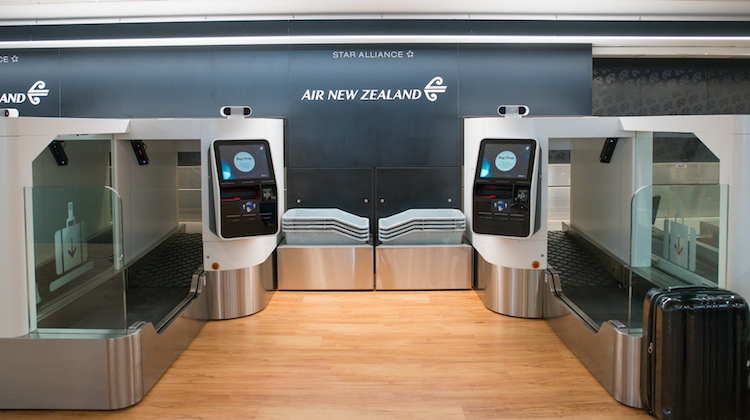
Air New Zealand will allow international passengers travelling from Auckland the option of checking in their own bag in what the airline describes as a world first.
The self-service bag drop kiosks read biometric data stored on passports using technology similar to the SmartGate passport control gates, with a camera to verify the passenger’s identity. Once the passenger’s identity has been verified, the bags are sent through to their flight. The airline said in a statement the kiosks use “world-first biometric technology”.
Air NZ said there five self-service bag drop kiosks have been installed, with plans for eight more to be added in early 2016. It also offers online checkin and has self-service kiosks in the terminal.
“We can now streamline the check-in process for our customers at Auckland International Airport and provide a more seamless airport journey,” Air NZ group general manager for airports John Whittaker said in a statement.
“It will reduce the time it takes for our customers to check in and free up our airport team to interact with customers and support them through the self-service process should they require assistance.”
Many airlines, including Air NZ, Qantas and Virgin Australia in this part of the world, already offer self-service bag drop facilities for domestic flights.
Air Baltic Corporation AS , Latvia’s national airline and the leading carrier in the Baltic States, announced that airBaltic and its subsidiaries participating in the voluntary Ch...
Lufthansa Technik Engine Services (LTES) is significantly expanding its engine maintenance capabilities in Tulsa, Oklahoma, nearly doubling its operational capacity as part of its growth strategy acro...
Electra has successfully completed the takeoff and landing of its hybrid-electric Ultra Short aircraft at Downtown Skyport in Lower Manhattan, in what is believed to be the first time a fixed-wing air...
Cirrus Aircraft has broken ground on a new 15,000-square-foot Engine Run-Up Center that will centralize engine testing, fuel calibration and certification activities for the SR Series, Vision Jet and...

