



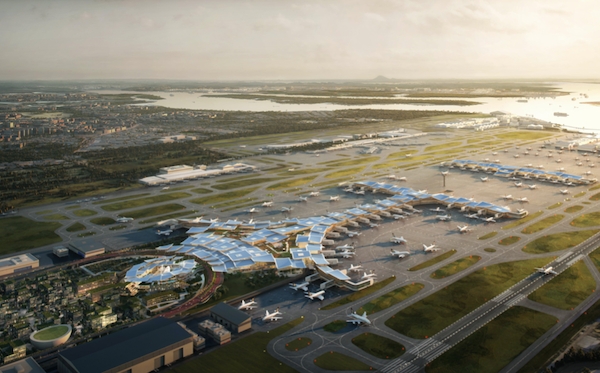
First announced in 2013, Changi Airport’s Terminal 5 is a project undertaken by the Ministry of Transport, the Civil Aviation Authority of Singapore and Changi Airport Group. Due to the Covid-19 pandemic, the T5 project was paused for two years. During this time, MOT, CAAS and CAG re-assessed the trajectory of aviation growth, and reviewed T5’s design to make it more modular, and to enhance its resilience and sustainability.
Following Singapore’s reopening, air travel demand has recovered strongly at Changi Airport. Beyond the immediate recovery, the long-term prospects for aviation also remain bright. In particular, the International Air Transport Association has projected that the Asia-Pacific would be the fastest-growing region for air travel over the next two decades.
To secure Singapore’s capacity to ride on the long-term growth of aviation, work on the T5 project has resumed. CAG is re-mobilising the design and engineering consultants to refine the T5 design. Construction is expected to commence in about two years, for T5 to be operational around the mid-2030s. T5 will be located within the 1,080-hectare Changi East development that is almost as big as the land area of today’s Changi Airport. It will be able to handle about 50 million passengers per year, and will be designed with the flexibility to be built in two phases, in line with traffic growth.
This additional capacity from T5 will strengthen Changi Airport’s position as a premier air hub for the region and beyond, and will ensure that future generations of Singaporeans can continue to benefit from Changi’s global connectivity.
A resilient airport that can handle future pandemics more nimbly
Drawing on lessons learnt from the Covid-19 pandemic, T5 will be designed with the flexibility to operate as smaller sub-terminals when needed, with space that could be converted for use during contingencies, such as for testing operations or the segregation of high-risk passengers.
Specialised provisions to reduce the transmission of diseases will also be deployed in T5. This includes contactless systems at passenger touchpoints, as well as enhanced ventilation systems that can be activated during a pandemic to increase the use of fresh air and minimise the mixing of air.
A green and sustainable terminal building
T5 will be a Green Mark Platinum Super Low Energy Building as certified by the Building and Construction Authority.
To reduce the carbon footprint of T5, solar panels, smart building management systems, as well as district cooling combined with thermal energy storage, will be deployed in the terminal building.
T5 will also be ready for viable alternative fuels including the use of Sustainable Aviation Fuel, and for the provision of fixed ground power and cooling for aircraft parked at the gates.
Designed for the deployment of automation at scale
T5 will leverage technology to automate and digitalise airport operations, to enhance the passenger experience and increase manpower productivity. For example, T5 could see the deployment of autonomous vehicles to support baggage and cargo transport on the airside, as well as robotics for baggage handling. The terminal will be designed to accommodate and facilitate deployment of such technology at scale.
These efforts will provide our local enterprises with an opportunity to build capabilities in new, emerging areas such as robotics and artificial intelligence, and ultimately create quality jobs for Singaporeans within the airport ecosystem.
A place connecting all Singaporeans
T5 will reinforce Changi Airport as a national icon, and ensure that it will continue to be a place of shared experiences across generations of Singaporeans, where we welcome and send off loved ones, and forge precious memories with friends and family.
T5 will be well-connected to the rest of Singapore, with a dedicated ground transportation centre where passengers can access rail, bus and other point-to-point transport services.
Located at the doorstep of T5, the Changi East Urban District (CEUD) will create new spaces for Singaporeans to connect, work and play. Master-planning for the development of the CEUD will be done in consultation with the Ministry of National Development, the Urban Redevelopment Authority and other agencies.
Image credit Changi Airport Group
PAL-V has signed a Memorandum of Understanding with AVION, a specialist in advanced flight training devices, and FLYVE, a developer of FlyDrive ecosystems for professional and government operator...
Rising production rates and the launch of new aircraft programs are driving increased demand for manufacturing capacity across the aerospace industry. To support this growth, FACC plans to i...
flyadeal, the fast-growing low-cost carrier of Saudia Group and one of the GCC's largest budget airlines, has expanded its presence in India with the launch of non-stop flights between Riyadh and...
TRU Simulation + Training Inc. will showcase its Veris Virtual Reality Flight Training Device (FTD) for the Cessna Skyhawk at NBAA-BACE 2026, marking the simulator's first appearance at the indust...

