



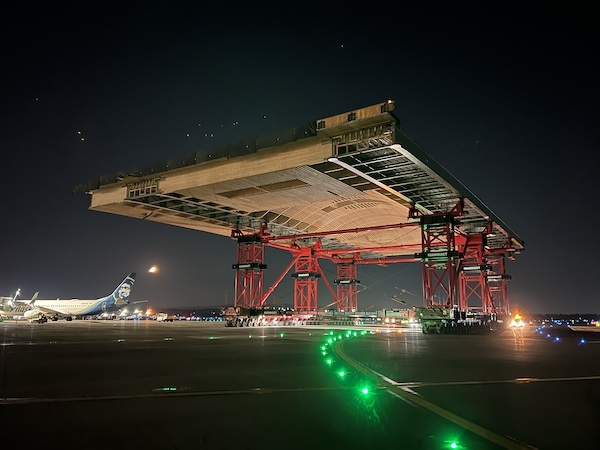
Portland International Airport anticipates substantial growth over the next two decades. PDX is scaling up in preparation to better serve 35 million passengers annually by undergoing a main terminal expansion project – nearly doubling its size. A key component of this expansion is the construction of a new, seismically isolated roof structure over the central area of the airport. Mammoet was contracted to jack up, transport, and install twenty roof panels of five distinct types at the airport, all while avoiding passenger disruption.
The roof, crafted mainly from regionally and sustainably sourced wood, was fully prefabricated between the active runways of the airport over the course of a year. Prior to being moved, the roof panels were disconnected into approximately football field sized pieces to be transported to the new terminal expansion. This allowed the airport to carry-on as usual while minimizing disruption to airport operations. Depending on the type of panel, each was launched, rolled into place, set directly with self-propelled modular transporters, or lifted with a crane into its final position.

The panels vary in weight between 40t and 632t, with dimensions up to 72m x 50m x 6m. Mammoet used four towers of Mega Jack 800 to jack up the roof panels to approximately 17m to allow SPMTs with falsework to be driven underneath each roof section. At midnight on the day of each move, the runways were closed for the one-mile transport of the panel from laydown yard to terminal. The roof sections were moved with care at a speed of about 1.6 kilometers, or one mile, per hour.
Most panels needed to be installed over the top of populated areas of the existing terminal building. With safety at the forefront of the entire project, work was done during strict overnight closures when the public could be kept clear of the work area. Once the area was verified to be clear of all pedestrians, the installation of the roof panels could begin. Each panel, referred to as a super cassette, was installed using stationary skidding propelled by strand jacks and lowered with the skidding jacks onto column isolators. The next set of panels were then rolled into position down the bottom flanges of the previously set panels. The panels were safely secured with consideration for potential elevated wind and project specific seismic requirements before the public were allowed to reoccupy the area below.

For the fourth consecutive year, Corsair is reaffirming its commitment to the fight against breast cancer by partnering with the association "Les Hôtesses de l’Air cont...
Rising production rates and the launch of new aircraft programs are driving increased demand for manufacturing capacity across the aerospace industry. To support this growth, FACC plans to i...
FL Technics Indonesia, the first MRO in Indonesia to be appointed as a GE Aerospace avionics support partner, has signed a service support agreement with GE Aerospace covering Boeing 737 and Airbus A3...
A new travel industry coalition is urging EU policymakers to adopt a balanced and proportionate approach to biometric travel, ensuring passengers can benefit from secure and seamless journeys while ma...

