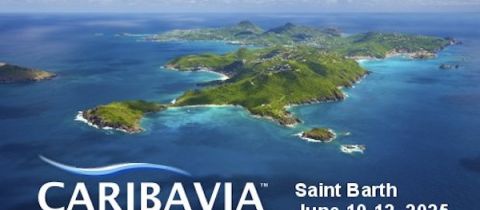
I've enjoyed getting to know Damien Richardson throughout the years. I met him just after Saint Martin, his home island, was ravaged by Hurricane Irma.His ability to see and suggest ideas that combine architecture, elegant design, and aviation requirements is what I find most astounding. As soon as you discover them, everything in detail seems absolutely obvious and necessary to realize immediately. Damien's project, "VASSO: composition of primary ports with a focus on global logistics, regional planning, and space tourism," earned him a Master of Science degree with honors in Architectural Design from the TU Delft School of Architecture.
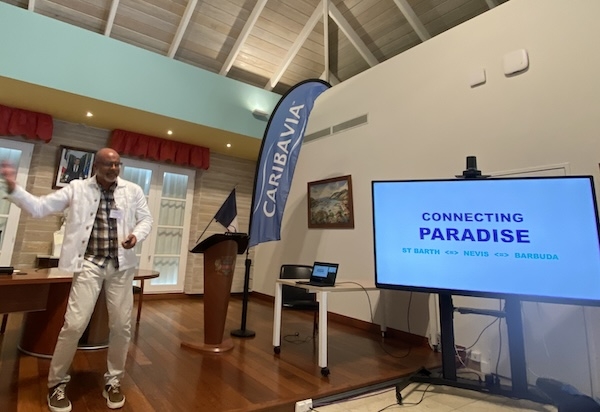
In order to deal with the construction of highrise buildings in Dubai, Damien conducted research on emergency escape pods using drones from high-rise buildings at the Technical University Delft's aerospace department. During CARIBAVIA 2025 Damien talked about vertiports for Caribbean eVTOL and connecting nearby islands with eVTOL planes.This topic is crucial, in fact. I like to ask lots of questions, even if they're not directly related to the presentation. As the agenda for the event was really full, we got together a little after 6 a.m. to chat. Here's the essential part of our conversation:
T.O. 06:25 local time in St Barth. Everything is good here at St Barth and we found a very calm spot close to the church to talk with Damien. Why ? Yesterday you shocked the audience with statement that aviation has to do something to connect islands and with a concept slightly different to everything we've heard before at CARIBAVIA. Can you tell us more?
D.R. Well, first off, thank you Tatjana, we know each other for quite a while right now. You know, to be honest, when we started to discuss with Bud CARIBAVIA, one of the things that came to light was of course we're dealing with vertiports and eVTOL. And then the most important thought came because of St Barth is the fact that St Barth is having a vision for these other islands namely Nevis and Barbuda. As a vision. With that from my side it was just normal, it just came natural to think of an idea to incorporate an idea of vertiports moving people between these three islands to suggest an alternative way of moving people. But also incorporating a way to protect these aircraft. Because they are multi million dollar aircraft. A lot of vision thought. But we're in the Caribbean and we are actually in the hurricane belt. So, it's only normal to create something that could assist in movement. Another element in there is a lot of times vehicles of this nature or even crafts they move out of the hurricane belt when hurricanes come. But the intention is always to think of strategies to keep things in place so that after the hurricane you have opportunity to move people, move cargo, etc. So it's always good to find a strategic way to keep certain assets in place to make sure protect your context. And that is what I think is very important about. Well, the idea that I bring to the table yesterday.
T.O. You are among people who are talking about protection. Honestly, this is not something what comes up and maybe more manufacturers should think, think about that. Because having an aircraft, an eVTOL, you can call it as you want, having an aircraft on place, that's the one. But, as you told, the nature is not always very elegant with Caribbean. There Is a real need to think about after what comes after and how to move people, goods, help, medical supply and everything.
D.R. I mean, one of the key things here, what you're saying is this, let's say every year there's a projection of a few hurricanes that are going to come. They might come in this direction, they might not. But you're significantly aware that there's going to be some kind of a hurricane or weather formation. But essentially the objective by having these kinds of investment is to make some money and also to create a certain level of experience for your audience, for your clients, etc. And that's what actually you're able to offer. You can offer your services, you can offer your experiences, but at the same time you. In every situation, there's always going to be that pot that you can have on the side to give back to the community that you're a part of. You're making money on the community. It's always important to say, hey, how can I give back? This is one way to give back. It's a costly give back, but you got to give back somehow. This is the way to protect your asset and also find a way to give back to the community.
T.O. What do you think about the acceptance? Of course, St Barth, let's say it's one question but if we take general public, what do you think about the acceptance of new technologies between islands? Is there a difference between audiences between Caribbean countries and islands?
D.R. Good question. What I realize is that, I mean, there is an acceptance. The main question then is implementation to implement. Right. But also what is maybe an interesting way of looking at it is that if there's a partnership, then there will be a, how to put it liberty in terms of giving certain benefits. Because you're bringing something to the audience and you're proven that you're going to do something for your country, the country that you're going to connect with. In that way they will be more willing to work with you because then they're seeing that you're not here just to take, but you're also here to give. And by representing that duality, I think most islands will be, yeah, let's go. You know, so you're bringing business opportunity. And I think one of the significant elements that Dorin* talked about in his presentation was the idea of slices. Every company, every organization has different parts. And I think within that context, when you come into an island or context, you can create a level of training in those different arenas so that it's not that they're just bringing technology but they're also bringing a level of training in the confidences of that technology knowledge. Yes. I think that duality because normally the students would go out to get trained and come back but here you have technology where captured audience immediately from the onset that you come in before you arrive, you should have already recruited so that the moment you touch ground here in the country, you should already have a local team working with you to facilitate activities. And that goes a very far away because the persons are working, they're getting paid. That means behind every person you're talking about 4, 5, 8, 10 people that are going to receive some benefits because of your being here. That's a big plus. You're not just coming to again take, you're also coming to give. And I think that way of giving is significant.

T.O. Way of giving. An easy question and an obvious one. What do you need to make it happen? Do you need partners? Do you need investors? Do you need local authorities cooperation, what?
D.R. That's correct. So if you're coming in, you're going to of course come and speak with because the type of investment that you're making, your it's not $5, it's a little bit 5 million, sometimes more. When you're making those levels of investment, you're going to need support. Youre going to talk to the. Whether it's like authorities, the government or certain local partners that you're going to, maybe vendors that you're going to work with. These kinds of discussions are normal, you know. And then like I say again, in terms of recruiting local persons to assist you want to also do that. Maybe there's a recruiting agency that you can partner with to discuss how you're going to. What's the technical side of recruiting persons for that job opportunity or those job opportunities. But I think it will be a it's a refreshing approach and a needed approach in today's world because things are changing, finances are changing. But if there's a way to again win, win that everyone can see that yes, you're here to win, we are here to win together again. That's a, the best way I think to make it happen.
T.O. So, you're open to be contacted by potential investors, potential manufacturers, potential operators. And you will be the one responsible for this project within Caribbean region.
D.R. Correct. That is correct at this time. Perfect.
T.O. From my side, I will do what is possible to spread the message. And spread your contact information, so people could reach you.
D.R. I'm right here in St Barth, I'm normally in St. Martin. Yes. But in the Golden Triangle, Anguilla. St. Martin, St. Barth. Which is the best. Yes.
T.O. Thank you very much. And I hope that next time we talk, i twill be already after first step towards the reality of the project.
D.R. Exactly. Thank you. Thank you again, Tatjana. Enjoy.
* Dorin Ivascu, from Romanian Airport Services
Archived
1 year ago

Oriens Aviation has appointed Narine Melkumjan as Sales Manager for the Netherlands, strengthening its presence in the Dutch market following its designation as Tecnam’s exclusive dealer in the...
Embraer reported a record backlog of US$35.7 billion in the third quarter of 2026, surpassing its previous all-time high by 3% quarter-over-quarter and increasing 14% compared with the...
Affinity Aviation Group (AAG), a leading provider of business aircraft sales, acquisitions and charter solutions, has entered into a strategic collaboration with Austria’s AeronautX, reinforcing...
The Tennessee Valley Authority is demonstrating the real-world value of the Tecnam P2012 Special Mission Platform (SMP), which has become a vital tool for monitoring and maintaining its...