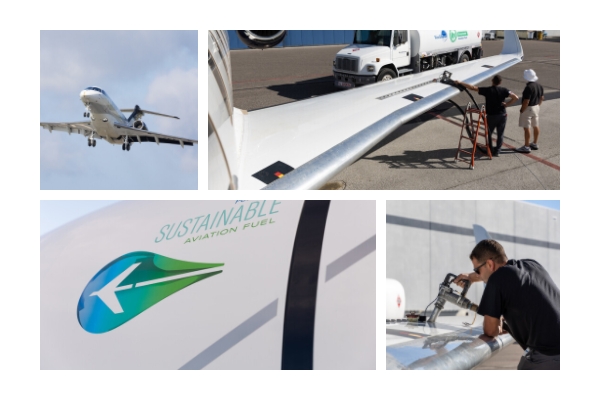
Embraer successfully tested the Phenom 300E and Praetor 600 on 100% neat sustainable aviation fuel. The tests, with one engine running on 100% SAF, were performed at Embraer’s Melbourne facility and provided significant insight into systems’ performance when utilizing blends up to 100% SAF, which was provided by World Fuel. Tests had collaboration of the engine and fuel system suppliers Honeywell Aerospace, Parker, Pratt & Whitney Canada and Safran.
The use of SAF is a critical part of Embraer's commitment to sustainability, and this milestone demonstrates the company's dedication to adapting our current products to be as sustainable as possible and promoting its adoption among customers and in the industry. SAF is a renewable energy source that can reduce greenhouse gas emissions by up to 80% compared to traditional jet fuel, making it a crucial part of Embraer’s targets of reaching carbon-neutral operations by 2040 and support the aerospace sector to achieve the net-zero emissions target by 2050.
Michael Amalfitano, Embraer Executive Jets President and CEO, commented: "We are proud to have successfully flown the Phenom 300E and Praetor 600 on 100% neat SAF, an important step as our operators are increasingly interested in and adopting this fuel. This achievement is an important milestone in our journey towards net-zero emissions by 2050 and demonstrates our commitment to sustainability, our customers and our stakeholders."

Currently, all Embraer aircraft are approved to use a blend of up to 50% of SAF mixed with conventional Jet Fuel, based on ASTM International specifications. However, possible future specifications allowing for fuels containing up to 100% SAF can maximize the potential for reducing emissions by utilizing sustainable, non-fossil-based sources.
Embraer’s commitment to sustainability is a core part of its business strategy, and the company is continuously exploring new ways to reduce its environmental impact. The Phenom 300 and Praetor 600 flights on 100% neat SAF are significant milestones in these efforts, and Embraer will continue working toward a more sustainable future for the aviation industry through additional efforts such as the research and development of low- and zero-emission alternative propulsion systems, such as electrification, hybrid-electric, and hydrogen.
Archived
2 years ago


The International Aircraft Dealers Association (IADA) has released its 2026-2027 Current Market Portrait & Forecast, offering an in-depth analysis of the global preowned business av...
PAL-V has signed a Memorandum of Understanding with AVION, a specialist in advanced flight training devices, and FLYVE, a developer of FlyDrive ecosystems for professional and government operator...
For the fourth consecutive year, Corsair is reaffirming its commitment to the fight against breast cancer by partnering with the association "Les Hôtesses de l’Air cont...
UH-60 Black Hawk helicopters operated by Helicopter Alliance played a vital role in combating wildfires across Central and Southern Europe during the aerial firefighting season that has now concluded....