



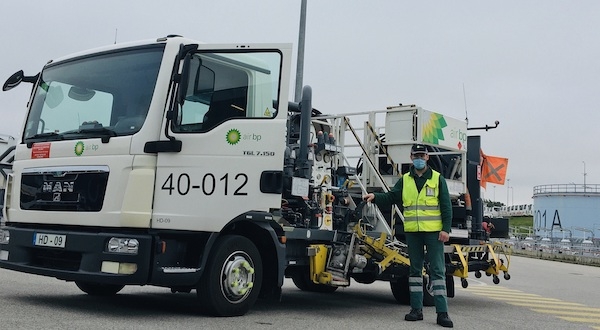
Air bp announced that all its fuel hydrant dispenser vehicles in Portugal now have stop-start technology. This is the first country in Air bp’s operated network to achieve the milestone and forms one element of the business’s carbon management plan. Effective immediately, Air bp will have start-stop technology installed on all its newly procured hydrant dispensers. The aim is that all existing hydrant dispensers across its global operated network, that are less than ten years old, will be retrofitted with the technology by the end of the year.
Start-stop technology automatically shuts down and restarts the vehicle engine to reduce the amount of time the engine spends idling, thereby reducing fuel consumption and emissions. Air bp’s hydrant refuelling vehicles equipped with start-stop technology have seen, on average, a 25% reduction in carbon emissions. This saving is estimated to be 3.5 tonnes of CO2e per vehicle per year.
To achieve this milestone, Air bp first identified that hydrant dispensers were the vehicles most suited to this technology. Air bp then worked with a selected supplier to design a system specific to Air bp’s hydrant fleet. Testing was completed to ensure the expected emissions savings were achieved and Air bp’s stringent technical safety requirements were met.
Since 2016 all Air bp’s global operated airport into-plane fuel facilities have been carbon neutral. An important part of maintaining carbon neutral status is having an effective carbon management plan.
Gigi Yuen, Air bp’s global carbon neutral lead, comments: “Our carbon management plan is a key part of Air bp’s global operations. In 2016, we made a 10-year pledge to retain our carbon neutral accreditation. In relation to start-stop technology, over the past two years we have worked hard to achieve this first milestone and continue to work determinedly towards achieving our aims.”
Some other initiatives Air bp has used and continues to use to reduce carbon emissions across its global operated facilities include: reducing the number of road journeys made by trucks; using electric powered vehicles and using an in-line magnetic filter, Magna-Strain, within pipelines to reduce the electrical demand on pumps.

For the fourth consecutive year, Corsair is reaffirming its commitment to the fight against breast cancer by partnering with the association "Les Hôtesses de l’Air cont...
Tecnam has announced a landmark strategic partnership aimed at accelerating the growth of its P2012 aircraft family across the United States. Under the agreement, Finnoff has been appointed the exclus...
British Airways has unveiled the next phase of its Heathrow lounge transformation programme, marking the beginning of a significant investment aimed at modernising every lounge across the airport in t...
flyadeal, the fast-growing low-cost carrier of Saudia Group and one of the GCC's largest budget airlines, has expanded its presence in India with the launch of non-stop flights between Riyadh and...

