Some 89% of senior executives at large U.S. corporations who use private jets believe the use of sustainable aviation fuel by the business aviation sector will increase over the next five years, with 56% anticipating a significant rise. This is according to a new study1 commissioned by Airbus Corporate Jets. SAF is a biofuel that can help reduce CO2 emissions by on average 80% over its lifecycle compared to traditional jet fuel. As the business aviation sector continues to explore improving its sustainability record by making greater use of SAF, 90% of those senior executives surveyed believe this will lead to an increase in U.S. companies using private jets. Half (49.5%) expect it to lead to a dramatic increase.
Similarly, as SAF becomes more affordable and easier for business aircraft to use, 87% of senior executives at large U.S. corporations interviewed expect it to lead to an overall increase in the sale of business aircraft. Airbus is increasing the use of SAF in its own operations, with a target of 15% SAF in its global fuel mix by the end of 2024 and at least 30% by 2030. Airbus supports the large-scale development of SAF and is actively engaged in certification processes and demonstration projects. It collaborates with airlines, airports, SAF producers and research institutions worldwide to help advance the SAF ecosystem, addressing the policy and regulatory environment and the drivers of supply and demand.
Chadi Saade, President, ACJ commented: “SAF is truly a game changer for aviation, and our research shows it could support future growth in the business aviation sector. Airbus is committed to leading the decarbonization of the aviation sector. That includes accelerating alternate fuels such as SAF through funding and working closely with a range of industry partners. All Airbus commercial aircraft and helicopters will be capable of operating with 100% SAF by 2030.”
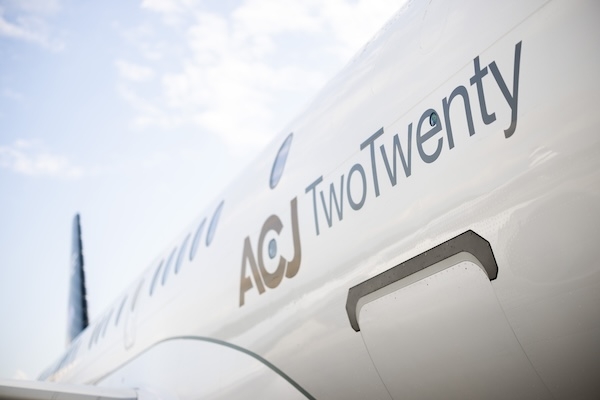
ACJ offers a range of large business aircraft. The recently launched ACJ TwoTwenty is carving out a whole new market segment – ‘The Xtra Large Bizjet.’The ACJ TwoTwenty offers twice the cabin real estate compared to similarly priced ULR business jets, combined with market-leading fuel efficiency and unrivaled reliability. It occupies the same parking footprint as competitive ULR jets and can take off from the same airports, but the ACJ TwoTwenty operating costs are one-third less.
With a range of up to 5,650 nm (more than 12 flight hours), the ACJ TwoTwenty can meet the requirements of 99.9% of all U.S. departures,2 connecting city pairs including Los Angeles to London, Miami to Buenos Aires, and New York to Istanbul.
As with all ACJ aircraft, the ACJ TwoTwenty is capable of flying with up to a 50% blend of kerosene and sustainable aviation fuel (SAF) while keeping to the technical specifications of Jet A. More than 200 Airbus corporate jets are in service worldwide.

Archived
1 year ago

Emirates has officially inaugurated services to Helsinki, marking a significant milestone in connectivity between Finland and the United Arab Emirates. The new daily route is the only year-r...
British Airways has unveiled the next phase of its Heathrow lounge transformation programme, marking the beginning of a significant investment aimed at modernising every lounge across the airport in t...
UH-60 Black Hawk helicopters operated by Helicopter Alliance played a vital role in combating wildfires across Central and Southern Europe during the aerial firefighting season that has now concluded....
Boeing and Ethiopian Airlines have announced a new cargo fleet expansion agreement, with the African carrier ordering eight 777-8 Freighters and two additional 777 Freighters. The investment will enab...