



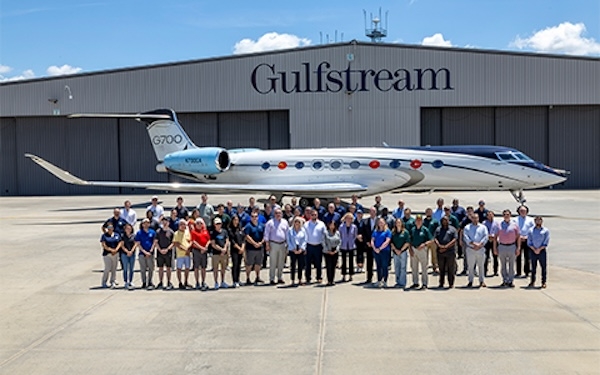
Rolls-Royce Pearl 700 engines successfully powered the first flight of the Gulfstream G800 using 100% Sustainable Aviation Fuel. The flight was part of Gulfstream Aerospace’s high-altitude flight test campaign, demonstrating the potential for 100% neat SAF to reduce contrail-forming particle emissions at altitudes up to 50,000 feet. The aircraft was paired with a specially modified Gulfstream G700, which is also powered by Pearl 700 engines, and was transformed into a flying emissions measurement laboratory. Operating in close formation, the aircraft enabled researchers to capture precise, real-world measurements of particulate matter and contrail-forming atmospheric characteristics at higher altitudes than flown by most commercial airliners, yet typical for business aviation.
Alan Newby Director of Research and Technology, Rolls-Royce, commented: "Sustainable Aviation Fuels in combination with compatible, ultra-efficient aero engines will not only play a vital role in decarbonising aviation but have also been shown to reduce certain non-CO2 emissions. The valuable insights we have gained from these latest tests at high altitudes, as well as the data from projects like QRITOS or ECLIF3, are driving real progress in understanding aviation’s non-CO2 climate impacts and potential mitigation options.”
Led by Gulfstream Aerospace and conducted in close collaboration with the Federal Aviation Administration, NASA, the German Aerospace Center, Missouri University of Science & Technology, Rolls Royce, Aerodyne Research, Montana Renewables and World Fuel Services, the campaign was designed to isolate how different fuel compositions influence non-CO2 emissions, an area of increasing focus across science and industry.
To accomplish this, the team compared conventional Jet-A aviation fuel, low-sulfur Jet-A, and neat HEFA (Hydro-processed Esters and Fatty Acids) SAF, which contains no sulfur or aromatics. Preliminary results suggest a significant, measurable reduction in the particulate emissions that contribute to contrail formation when operating on neat SAF.
The campaign demonstrates how Gulfstream and Rolls-Royce are aligned in advancing environmental performance across the aerospace industry. The data will be used in partnership with the broader aviation and atmospheric science communities to refine analytical models, inform future fuel standards, and support the development of operational strategies to reduce the environmental impact of air travel.
The tests showed once again that all of Rolls-Royce’s in-production Trent and business aviation engines can operate with 100% SAF, laying the groundwork for moving this type of fuel towards certification. At present, SAF is only certified for blends of up to 50% with conventional jet fuel. Sustainable Aviation Fuel has the potential to reduce net CO2 lifecycle emissions by about 80% compared to conventional jet fuel.


Boeing and Ethiopian Airlines have announced a new cargo fleet expansion agreement, with the African carrier ordering eight 777-8 Freighters and two additional 777 Freighters. The investment will enab...
British Airways has unveiled the next phase of its Heathrow lounge transformation programme, marking the beginning of a significant investment aimed at modernising every lounge across the airport in t...
FL Technics Indonesia, the first MRO in Indonesia to be appointed as a GE Aerospace avionics support partner, has signed a service support agreement with GE Aerospace covering Boeing 737 and Airbus A3...
flyadeal, the fast-growing low-cost carrier of Saudia Group and one of the GCC's largest budget airlines, has expanded its presence in India with the launch of non-stop flights between Riyadh and...

