Kawasaki Motors became VoltAero strategic investor, joining Series B funding for the development, production and certification of VoltAero Cassio electric-hybrid aircraft family.This investment marks Cassio program latest milestone, uniting VoltAero and Kawasaki in a shared vision for the future of electric aviation.The Series B round marks the third funding phase for VoltAero, positioning it for the industrialization of its Cassio 330 – the first in Cassio’s electric-hybrid aircraft family.
Jean Botti, VoltAero’s CEO & Chief Technology Officer, commented: “Kawasaki’s engine expertise and its capacity for innovation brings a new dimension to VoltAero as we complete the final definition of our electric-hybrid powertrain for the Cassio aircraft family. Having Kawasaki as a strategic investor is another major vote of confidence for the Cassio program.”
Hiroshi Ito, President and CEO of Kawasaki Motors Ltd., said: “We were deeply impressed by VoltAero’s creative design and innovative technology in the aviation industry, as well as its strong sense of mission to help realize a carbon-neutral society, and decided to invest in VoltAero. We are delighted to contribute to VoltAero’s business growth through this investment.”

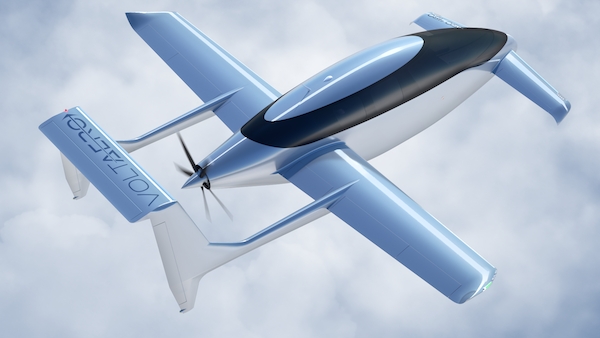
VoltAero airframe design for the Cassio series of airplanes is based on a sleek, aerodynamically-optimized fuselage, a forward fixed canard, and an aft-set wing with twin booms that support a high-set horizontal tail. By integrating VoltAero’s patented electric-hybrid propulsion system into the company’s purpose-designed airframe, the Cassio aircraft family will deliver an order of magnitude higher performance as compared to the current competition, and provide significantly lower operational costs.
The VoltAero propulsion concept is unique: Cassio aircraft will utilize electric motors in the aft fuselage-mounted propulsion system for all-electric power during taxi, takeoff, primary flight (if the distance traveled is less than 150 km.), and landing. The hybrid feature – with an internal combustion engine – comes into play as a range extender, recharging the batteries while in flight. Additionally, this hybrid element serves as a backup in the event of a problem with the electric propulsion, ensuring true fail-safe functionality.
Production Cassio airplanes will be built in three versions, each sharing a high degree of modularity and commonality. The family will provide a highly capable and reliable product line for regional commercial operators, air taxi/charter companies, private owners, as well as in utility-category service for cargo, postal delivery and medical evacuation (Medevac) applications.
First to enter service is the Cassio 330, with five seats and powered by the 330-kilowatt electric-hybrid propulsion system. VoltAero’s follow-on six-seat Cassio 480 will have an electric-hybrid propulsion power of 480 kilowatts, while the Cassio 600 is sized at a 12-seat capacity with electric-hybrid propulsion power of 600 kilowatts.
Archived
3 years ago


Embraer reported a record backlog of US$35.7 billion in the third quarter of 2026, surpassing its previous all-time high by 3% quarter-over-quarter and increasing 14% compared with the...
Asco, a subsidiary of Montana Aerospace AG, achieves significant technological milestone in the development of a hybrid multi-material Rear Secondary Structure for Airbus. Montana Aerospace,...
A professional training device such as the new PC-12 PRO simulator is built on flight data supplied and validated by Pilatus. Drawing on actual flight-test and performance data, it accurately reproduc...
Affinity Aviation Group (AAG), a leading provider of business aircraft sales, acquisitions and charter solutions, has entered into a strategic collaboration with Austria’s AeronautX, reinforcing...