



Once again I will tell - this is something we discuss so very rarely, that many people have not even an idea of what industry does on everyday basis - search and rescue service, medevac services. Despite it is quite emotional, I consider it is more than important to know what and how is done inorder to assure the best possible in case it's needed.
The smaller the patient, the bigger the challenge can be – and when it comes to treating premature babies on the move, a stable and secure travelling environment is absolutely crucial.European Air Ambulance has particular expertise in dealing with pre-term and newborn babies, and has just invested in a new device to further improve the service it offers in this extremely demanding field of aeromedical transport.
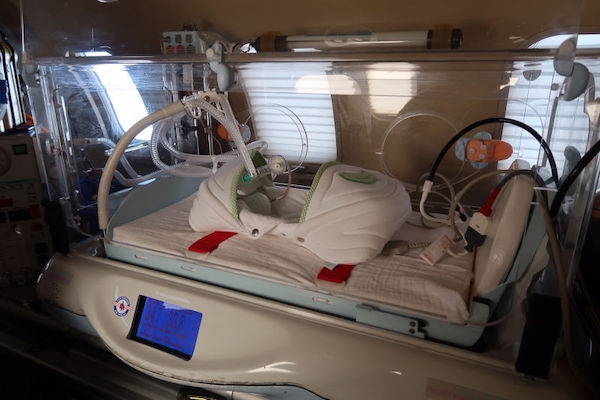
EAA, one of Europe’s largest specialised air ambulance service providers, has added a ‘Traveller’ system to its extensive list of high-tech equipment – a cocoon that secures and protects the baby in the incubator, holding him or her securely even if the flight hits turbulence.
Specialist neonatologist with European Air Ambulance Dr Jean Bottu explained: “Surprisingly, there are few systems to safely secure a newborn in an incubator, and medical teams are often forced to improvise - using mattresses or straps that aren’t really suitable for premature babies and that limit access, making it harder for medics to feed, change or administer treatment.
“The ‘Traveller’ system, designed by ConceptNatal to fit our transport incubator, is a cocoon that attaches to the interior with adjustable straps, allowing us to wrap the baby in a kind of secured and stable shell, protected from turbulence during the flight.”
The quilted cocoon absorbs vibrations and allows easy access to the tiny patient. It has adjustable head and foot panels, is machine washable and come in three sizes to suit babies weighing between 500g and 4000g.
It is the latest addition to EAA’s state-of-the-art equipment list, that allows medics to replicate as closely as possible a neonatal intensive care unit, with travel incubators constantly pre-heated and ready to be loaded onto one of its six dedicated air ambulance aircraft for missions worldwide.
EAA is also the only air ambulance company to have a dedicated neonatology team on stand-by 24/7 - and in 2019 introduced a new duty roster, ensuring a specialised neonatologist/paediatrician and flight nurse can be at the airport within an hour of a mission being activated.
Patrick Schomaker, Director Sales & Marketing at EAA said: “We are always looking to improve, and we put particular emphasis on our neonatal and paediatric aeromedical transport services. By investing further in this area, we can offer the very best care in the air to these tiny passengers.”

The Tennessee Valley Authority is demonstrating the real-world value of the Tecnam P2012 Special Mission Platform (SMP), which has become a vital tool for monitoring and maintaining its...
Airbus 2026 Cargo Global Market Forecast, unveiled at the Cargo Facts Symposium, predicts that the global fleet of dedicated freighter aircraft will expand by 46%, rising from 2,360 aircraft in 2026 t...
Bombardier announced plans to further expand its presence across the United States, with the creation of 800 jobs supported by ongoing growth initiatives and strategic infrastructure investments. ...
MTU Maintenance and Garuda Indonesia have entered into a three-year agreement for the maintenance, repair and overhaul of the airline’s GE90-115B engines, which power its fleet of eight Boeing 7...

