



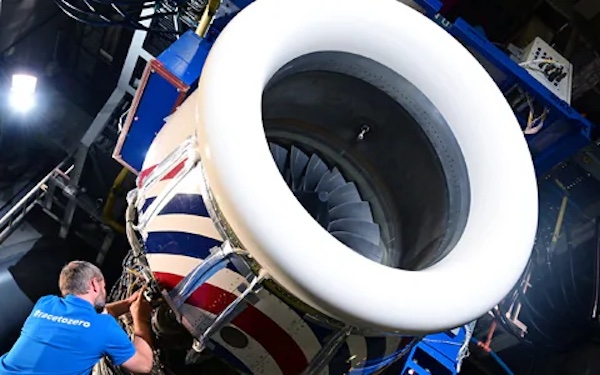
Rolls-Royce successfully completed of a series of tests with 100% SAF on its latest generation of business aviation engines, the Pearl 15 and the Pearl 10X. The Pearl 15, the first member of the Pearl engine family, powers Bombardier’s Global 5500 and 6500 aircraft, while the Pearl 10X will power Dassault’s ultra-long-range flagship aircraft, the Falcon 10X. The tests took place at Rolls-Royce’ Business Aviation headquarters in Dahlewitz, Germany, and are part of the company’s ongoing ambition to play a leading role in the journey to achieve net zero flight by 2050.
Dr Dirk Geisinger, Director Business Aviation, Rolls-Royce, commented: "Sustainable Aviation Fuels are a key element of our sustainability strategy, as they will play an important role in decarbonising long-haul flight. With its outstanding environmental performance, the Pearl family is already setting new standards in the ultra-long-range corporate jet market.”
As well as proving compatibility with 100% SAF another target of the test campaign was to run a back-to-back engine test with both Jet A-1 and SAF on the same Pearl 10X engine. The aim was to confirm further improvements in the environmental footprint when switching to SAF. The results from this first back-to-back engine emission test under standard certification conditions provides important correlations for the evaluation of future SAF within our environmental strategy. The Hydro-processed Esters and Fatty Acids SAF was produced from waste-based sustainable feedstocks such as used cooking oils and waste fat. This fuel has the potential to significantly reduce net CO2 lifecycle emissions by about 80% compared to conventional jet fuel.
The back-to-back tests conducted with conventional fossil-based fuel and subsequently SAF also confirmed a cleaner combustion of the sustainable fuel, with significantly lower levels of non-volatile particulate matter (nvPM). In combination with the low NOx combustor technology of the Pearl 10X and its additive manufactured combustor tiles a reduction of all emissions was achieved.
The tests demonstrated once again that Rolls-Royce’s current engine portfolio for large civil and business jet applications can operate with 100% SAF, laying the groundwork for moving this type of fuel towards certification. At present, SAF is only certified for blends of up to 50% with conventional jet fuel. By the end of 2023 Rolls-Royce will have proven that all its in-production Trent and business aviation engines are compatible with 100% SAF.


The U.S. Federal Aviation Administration has certified the Boeing 737-10, the newest and largest member of the 737 MAX family, paving the way for Boeing [NYSE: BA] to begin customer deliveri...
Affinity Aviation Group (AAG), a leading provider of business aircraft sales, acquisitions and charter solutions, has entered into a strategic collaboration with Austria’s AeronautX, reinforcing...
Lufthansa Technik Engine Services (LTES) is significantly expanding its engine maintenance capabilities in Tulsa, Oklahoma, nearly doubling its operational capacity as part of its growth strategy acro...
Confidence among the world’s leading accredited aircraft dealers strengthened in the third quarter of 2026, reflecting continued momentum in the preowned business aviation market. According to t...

