



Investigators probing the fatal 29 April crash of an Airbus Helicopters H225 on the Norwegian coastline are continuing to dismiss pilot actions as a likely cause and also say they have so far found no evidence of "fatigue failure".
In the SHT agency’s first interim report, issued 14 days after the accident, it stresses that there “are no indications that flightcrew actions were a major factor” in the incident.
Information extracted from the combined voice and flight data recorder shows a “normal” flight “until a sudden catastrophic failure developed in 1-2 seconds”, it says.
This caused the main rotor assembly to separate from the rest of the CHC Helikopter Service-operated H225 (LN-OJF) at around 2,000ft, with the fuselage and its 13 occupants plunging to the ground, none of whom survived the impact.
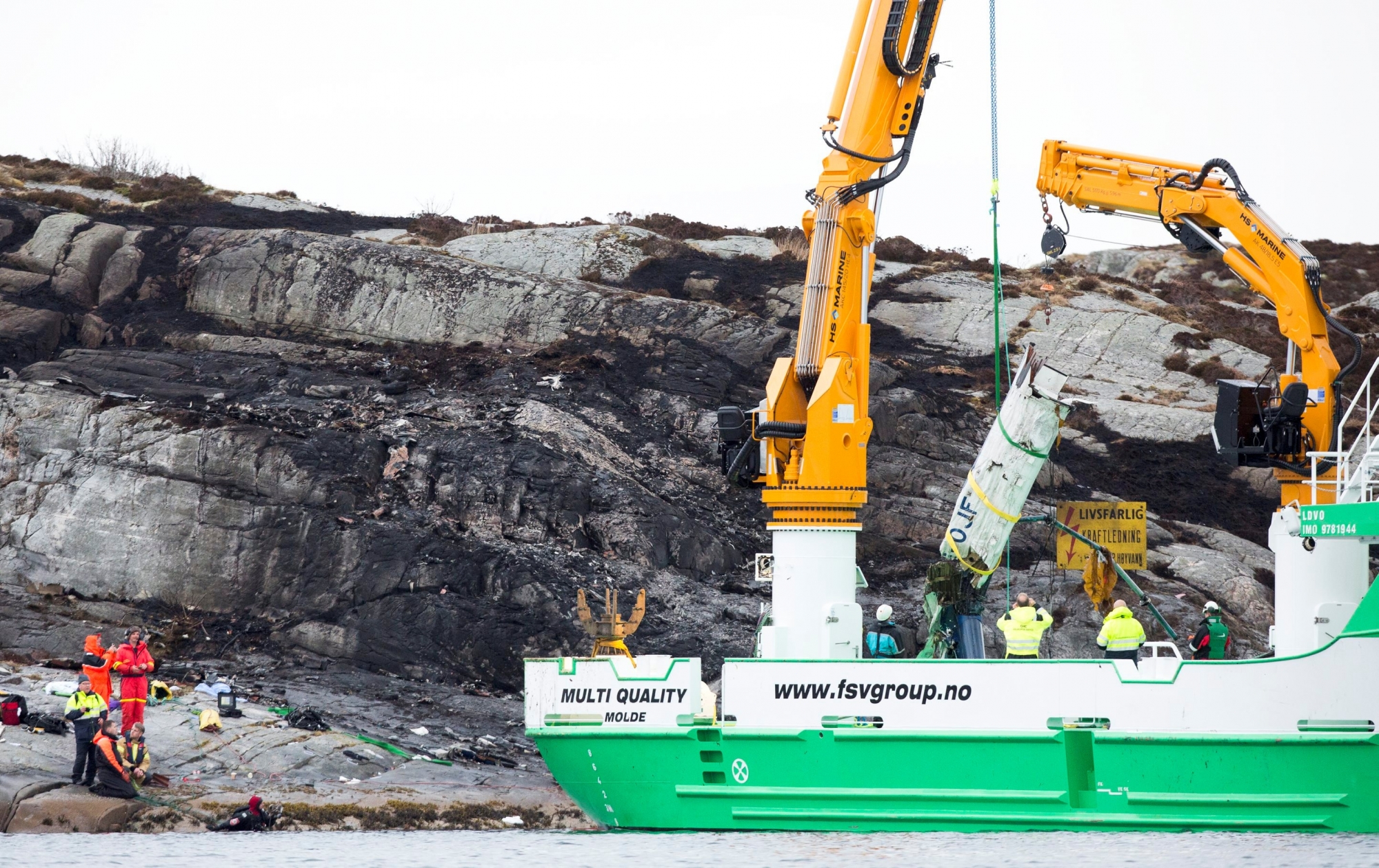
SHT has moved the wreckage recovered to its facility in Lillestrøm and “is currently focussing on the examination of the [main rotor] suspension bar assembly, the main gearbox and the main rotor head,” it says.
However, the search for scattered debris continues as “several key components are still missing”.
Images contained in the update show that the left- and right-hand aft suspension bars have been recovered, but there is no photographic evidence in the report of the single forward suspension bar.
An emergency airworthiness directive issued in the immediate aftermath of the crash mandates operators to check the suspension bars, oil filters and chip detectors, and vibration monitoring systems.
However, a service bulletin issued by the manufacturer focuses solely on the integrity of the suspension bars.
Although SHT notes that “detailed metallurgical examinations” of any components are yet to be performed, “the examinations so far have not shown any sign of fatigue failure.”
“We have barely started to put together the picture. It is therefore impossible to say how many parts we lack,” chief investigator Kåre Halvorsen told local media.
Meanwhile, flight restrictions banning the commercial transport operation of the H225 in Norway and the UK have been extended to the older AS332 variant of the Super Puma based on “the close similarities between the two types”, says the UK Civil Aviation Authority.
The restriction applies “until further information is available” says the CAA.


Tecnam introduces the P2008JC NG to the United States market, bringing flight schools a certified, next-generation training aircraft designed to dramatically reduce operating costs while maximizing fl...
British Airways has unveiled the next phase of its Heathrow lounge transformation programme, marking the beginning of a significant investment aimed at modernising every lounge across the airport in t...
Sky Travel and parent company Cove Capital Investments, LLC, have unveiled plans to bring nearly 20 business aircraft to market during Q4 2026, reinforcing their commitment to meeting growing demand f...
In a landmark step towards next-generation regional aircraft manufacturing, Jungheinrich has delivered an advanced automated logistics centre to Deutsche Aircraft at Leipzig/Halle Airport. Supporting...

