



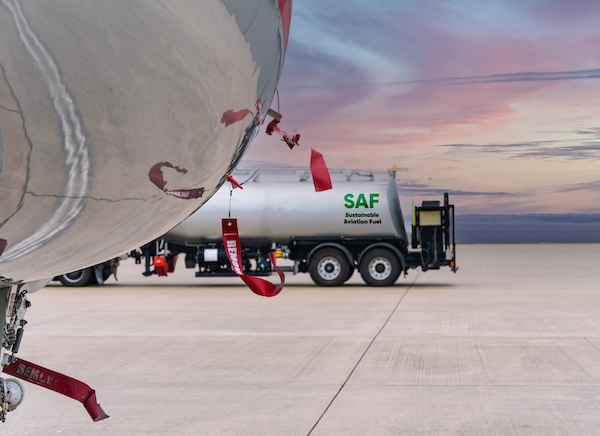
VistaJet continues to push forward with its plan for more sustainable aviation solutions and announces an agreement with AEG Fuels to purchase Sustainable Aviation Fuel produced by OMV at Vienna International Airport. Leading the industry by integrating a series of environmental initiatives throughout its operations, the agreement accelerates VistaJet's journey to carbon neutrality 2025. VistaJet commitment to replace over 200,000 USG of conventional jet fuel consumption with a blended SAF is expected to generate over 165,000 kg of CO2 reduction — an 80% emissions improvement over the lifecycle of the fuel compared to conventional jet fuel. This SAF is produced in compliance with the EU Renewable Energy Directive .
VistaJet Founder and Chairman Thomas Flohr commented: “Together as an industry we can reshape the way we conduct business. At VistaJet, we are very proud of the progress we have made and we hope that others will adopt our recommendations. Businesses are rightfully being held accountable for their environmental impact and our agreement with AEG Fuels not only helps in reducing GHG emissions, but goes hand in hand with our ongoing efforts to practice higher sustainability to protect the local communities in the countries we operate, spanning 96% of the world.”
Stephen J. Leonard, Vice President of Global Supply, AEG Fuels said: “Business and corporate jet operators are going to be key stakeholders in aviation’s decarbonization plans as we work to achieve net-zero. We’re very excited to support VistaJet’s efforts to push our industry forward and provide a framework for future SAF agreements. Their individual efforts are supporting critical investments in sustainable solutions for producers and consumers in the space.”

Founded in 2004, VistaJet revolutionized business aviation from its inception, providing access to a global fleet without the need to own an aircraft. This new way to fly means fewer aircraft produced, and also reduced repositioning flights, as the fleet is managed on a floating model instead of the wasteful hub-and-spoke system.
Private aviation has seen unprecedented growth since the pandemic, as travel continues to be a necessity for companies to ensure business continuity and point-to-point connections on fuel-efficient smaller aircraft. VistaJet is simultaneously making every effort to reduce the industry’s impact on the environment.
Proving its commitment to change, in April 2021 VistaJet pledged to be fully carbon neutral across its entire business by 2025. Urging the aviation industry to step up and do its part to combat climate change, VistaJet’s commitment is also aimed at pushing the sector to go further than the current goal of net-zero carbon emissions by 2050 set by the civil aviation industry bodies and IATA. Only a multi-party contribution can reduce impact in scale and bring about an industry-wide transformation to drive systemic transformation.
While offsets and SAF are the main options currently available to reduce carbon footprint, VistaJet continues to actively seek and invest in new developments to help push beyond the current limitations, looking at new technology and innovations to further reduce GHG footprint in line with the latest available science. Following years of research, innovative technology exploration and working with clients, the industry and regulatory bodies, VistaJet already has:


For the fourth consecutive year, Corsair is reaffirming its commitment to the fight against breast cancer by partnering with the association "Les Hôtesses de l’Air cont...
flyadeal, the fast-growing low-cost carrier of Saudia Group and one of the GCC's largest budget airlines, has expanded its presence in India with the launch of non-stop flights between Riyadh and...
Dutch flag carrier KLM, part of the Air France-KLM Group, has welcomed its first Airbus A350-900, marking a significant step in the airline’s long-haul fleet modernization strategy. The arrival...
Emirates has officially inaugurated services to Helsinki, marking a significant milestone in connectivity between Finland and the United Arab Emirates. The new daily route is the only year-r...

