




Before the modern jumbo jet and its first class suites, the biggest and grandest thing in luxury air travel was the German Zeppelin Airship.
Of all the massive Zeppelin's constructed, the most famous was the Hindenburg, which crashed in New Jersey in 1937. The Hindenburg was designed to ferry passengers across the Atlantic in serenity, with the dirigible floating smoothly through the clouds.
The Hindenburg was the first of two "Hindenburg" Class airships constructed by the Zeppelin Company. Construction of the airship began in 1931 and was completed in 1936. The Hindenburg, along with its highly successful predecessor, the Graf Zeppelin, made numerous trans-Atlantic crossings in their brief but illustrious careers.
Constructed out of an aluminum alloy called duralumin, the Hindenburg's massive frame work was filled with 7 tons of hydrogen. Hydrogen is much lighter than air, and allows the massive Zeppelin to carry more people in greater levels of luxury. However, with an ignition source, an oxidizer, and right concentration, hydrogen can also be incredibly flammable. This is the theory of what happened in 1937 when the Hindenburg went down.
The Hindenburg entered passenger service in May of 1936 and carried up 50 passengers in luxury across the Atlantic.
The legend of the Hindenburg's luxurious amenities are well known, but most have not seen them in living color. So take the opportunity to check out these wonderful photos of the Zeppelin's passengers spaces courtesy of airships.net and the German Federal Archive.
Prior to the age of the airliner, Zeppelin airships ruled the skies over the north Atlantic — connecting cities like New York with Western Europe. Zeppelin's fleet of airships included such colossal creations like the Graf Zeppelin and the Hindenburg (seen here) along with the less famous Graf Zeppelin II.

AP
In fact, here's a photo of Business Insider's world headquarters taken from the Graf Zeppelin in 1929.

Youtube/Michael Rogge
The most well known of the Zeppelin airships was named after former German President Field Marshal Paul von Hindenburg.

Wikimedia Commons
Also known as the LZ129, the 803 foot-long vessel was nearly four-times the length of a Boeing 747.

Wikimedia Commons
The Hindenburg was also fast. It's quickest transatlantic crossing took a mere 43 hours. This was a drastic improvement of the 4 days it took even the speediest of the ocean liners.

Wikimedia Commons
However, the Hindenburg's ultimate calling card was its luxury. The airship's luxury accommodations like the dining room — seen here — were located within its fabric hull, while the gondola where the crew commanded the ship was located below.

Airships.net Collection
However, there were windows so passengers could enjoy the beautiful view as they floated over the ocean.

Airships.net Collection
The 19-foot-wide and 43-foot-long dining room featured silk wallpaper depicting the exploits of the Hindenberg's sister ship, the Graf Zeppelin. The chairs were even made from tubular aluminum to reduce weight.

Airships.net Collection
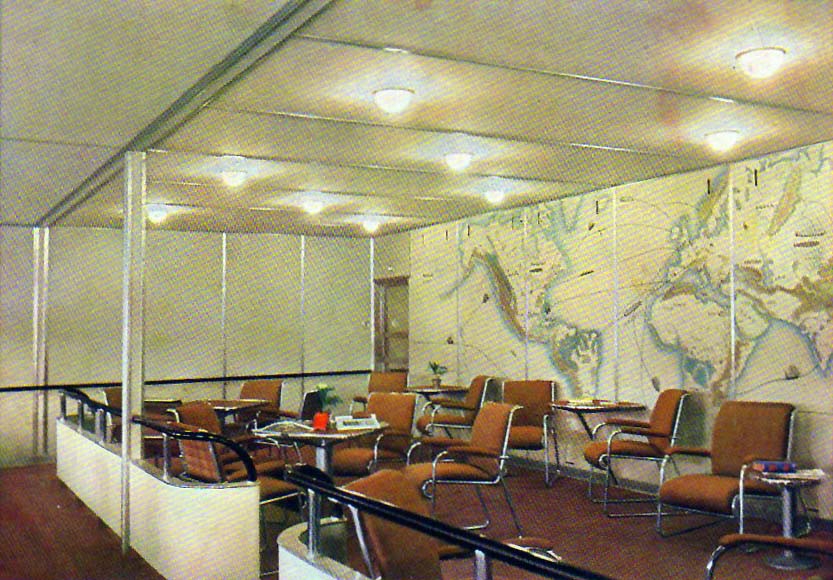
Located near the dining room was the Hindenburg's lounge. It, too, featured lightweight aluminum seats — see here upholstered in brown. During its first year of service in 1936, the lounge even featured a grand piano. However it was removed in 1937 and was not onboard for the final flight.

Airships.net Collection
The wall of the lounge was covered with a large mural depicting the routes taken by famous explorers, ocean liners, and other Zeppelins.

Airships.net Collection
Next to the lounge was a writing room where passengers could spend some time in peace.

Airships.net Collection
Sandwiched in between the lounge and the dining room were the Hindenburg's passenger cabins. They measured 78" X 66" and featured a pair of bunk beds.

Airships.net Collection
One deck below the dining room, lounge, cabins, and writing room was the smoking room and bar. This was an odd feature to have for a ship filled with 7 tons of highly combustible hydrogen. But smoking was much more common back then.

Airships.net Collection
Rightly so, the smoking room was separated from the rest of the Zeppelin by an airlock and the room was kept at a positive air pressure so no hydrogen could leak in. In addition, no open flames were allowed in the area and a single electric lighter was provided instead.

Airships.net Collection
Exactly one year after its maiden passenger carrying flight, the Hindenburg was destroyed in a fiery inferno as it attempted to land at Lakehurst, New Jersey. 35 people onboard the airship along with one person on the ground perished in the tragedy. Amazingly, 62 of the 97 onboard survived.

AP
The fire was blamed on a spark that caused the Zeppelin's hydrogen to ignite. Although conspiracy theories over the cause of the tragedy abound.

AP
The crash of the Hindenburg marked the end of the airship era and ushered in the rise of rise of airlines like Pan Am. By 1940, the two remaining Zeppelin airships were scrapped on the order Germany's Nazi regime so their parts could be used to build weapons of war.

Tecnam introduces the P2008JC NG to the United States market, bringing flight schools a certified, next-generation training aircraft designed to dramatically reduce operating costs while maximizing fl...
Dutch flag carrier KLM, part of the Air France-KLM Group, has welcomed its first Airbus A350-900, marking a significant step in the airline’s long-haul fleet modernization strategy. The arrival...
Tecnam has announced a landmark strategic partnership aimed at accelerating the growth of its P2012 aircraft family across the United States. Under the agreement, Finnoff has been appointed the exclus...
For the fourth consecutive year, Corsair is reaffirming its commitment to the fight against breast cancer by partnering with the association "Les Hôtesses de l’Air cont...
