



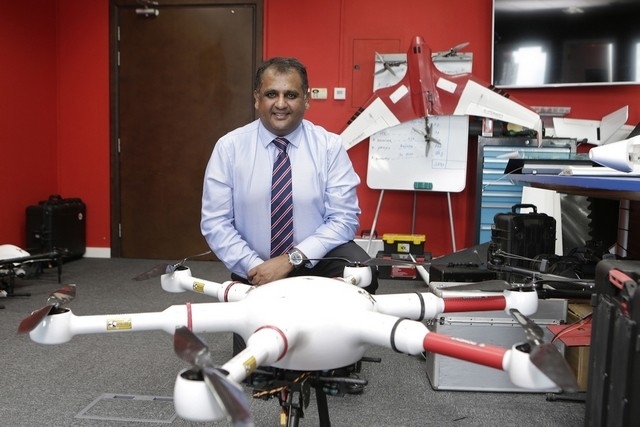
Drones are taking off – but, as the most recent shutdown of Dubai airspace shows, the rise of the technology is causing considerable turbulence.
Aside from recreational use, there are numerous commercial applications for unmanned aerial vehicles (UAVs), ranging from infrastructure inspections to document deliveries.
But some specialist UAE drone consultancies have a warning for businesses looking to ride this new wave of technology. Asam Khan, the chief executive of the Dubai-headquartered Exponent Technology Services, which develops drone technology for commercial use, says businesses need to be very clear about the relevant rules and responsibilities.
"It’s very easy to run out and go buy a drone and say ‘let’s see what we can do with it’. But really it’s not the solution," says Mr Khan, a Pakistani former banker who holds a private pilot’s licence.
"Commercial operators … really need to understand that flying drones is not a fundamental human right, let’s put it that way. You have to be very careful how you use it. You have to understand [that] you share the national airspace."
An illustration of the importance of responsible drone use came in September, with the latest of several shutdowns of airspace around Dubai International Airport because of "unauthorised drone activity" in the area.
Despite the expensive fallout of such instances – which globally often stem from individual, rather than commercial misuse of drones – consultants say the technology has great potential for both making, and saving, businesses money.
Exponent’s US subsidiary in August undertook a test inspection of part of the Gold Star Memorial Bridge in Connecticut. A drone video inspection of the full bridge would have cost between US$18,000 and $24,000, and taken two people about three or four days to complete, Mr Khan says. But without using a drone, inspecting the bridge manually would require a crew of 12 to 14 working 72 days, costing about $100,000, according to Exponent.
Services already offered by the company include drone-powered inventory tracking, water-sample retrievals, security surveillance and 3D mapping. The company will either build a client a drone from scratch or adapt an off-the-shelf model, as well as providing sensors, communications devices and software.
The consultancy’s clients in the UAE include DP World and "several major government" entities, Mr Khan says. Another organisation it is working with is the Dubai Civil Aviation Authority, with which it is developing a live tracking system for drones, which it plans to launch this month. The "revolutionary" system will be akin to an air traffic control for drones, Mr Khan says.
The need for such a system becomes all the more apparent given what is on the horizon for the devices in the UAE. In 2014, for example, officials unveiled ambitious plans to use UAVs to deliver government documents and packages to citizens.
Regulation is "the major challenge" in the evolution of drone use, Mr Khan says, adding that the UAE is "way ahead of even most industrial countries" in this regard.
National rules require that recreational users of drones greater than half a kilogram in weight register with the UAE General Civil Aviation Authority (GCAA); in Abu Dhabi the sale of recreational drones is banned altogether. Business users must comply with different rules, and are required to obtain both GCAA operating approvals and – when cameras are used – security clearance.
Given such requirements, another Dubai-based UAV consultancy offers advice to businesses wanting to launch drone operations.
David East founded DroneWorks in 2014 and now runs it with three other partners on a part-time basis. The Briton certainly knows the ropes of the aviation world, given his day job as a commercial airline pilot.
"There’s this misconception that [drones] are just so easy to operate and you don’t need to have any kind of ability. And yet the regulation is very strict – you have got to be very qualified," he says.
"To work commercially in this region, you need to have a commercial licence to operate drones, just like flying an airplane."
Mr East agrees, however, that drones have great potential. His company worked on a test project in the UAE last year with Nokia Networks and du, which included the use of drones for inspecting telecom towers.
"It’s reckoned to be a multibillion dollar industry that is coming," Mr East says of the drone business. "The sky is the limit, so to speak."
Azerbaijan Airlines (AZAL), part of AZCON Holding, has taken delivery of another Airbus A321neo, increasing its fleet to 31 aircraft as the carrier continues its long-term modernisation strategy. The...
Following the successful public flight demonstrations at Expo 2025 Osaka, SkyDrive announced plans to undertake a feasibility study exploring the conversion of Osaka City’s existi...
As the first aviation company in Kansas to introduce state-registered youth apprenticeships through the Kansas Office of Apprenticeships, Textron Aviation is taking a leading role in workforce develop...
Tecnam introduces the P2008JC NG to the United States market, bringing flight schools a certified, next-generation training aircraft designed to dramatically reduce operating costs while maximizing fl...

