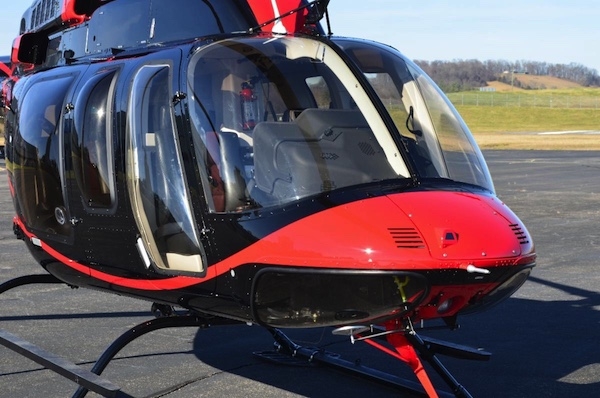
Astronics Corporation announced that an amended Supplemental Type Certificate has been approved by Transport Canada Civil Aviation for its Max-Viz 1400 and 1200 Enhanced Vision Systems on Bell 407 helicopters. Astronics expects that the U.S. Federal Aviation Administration (FAA) validation will follow within six months. Astronics obtained the approval for its MaxViz 1400 and 1200 EVS in cooperation with AVIO dg in Calgary, Canada. The first installation of the certified Max-Viz 1400 equipment is on a Bell 407GXI, for a VIP client, by Wysong Enterprises, Inc.
"The Astronics Max-Viz technology provides pilots with an unprecedented level of situational awareness and safety," said Tom Geiger, Max-Viz Business Unit Director for Astronics. "We worked closely with AVIO dg to get this technology approved for daily missions on Bell 407 series helicopters," he added.
Astronics' Max-Viz 1200 and 1400 systems are lightweight, solid-state, low power, and feature an uncooled thermal camera. The sensor image displays on any cockpit equipment that accepts NTSC or PAL/Analog RS-170 video signals, including MFDs (Multi Function Displays), PFDs (Primary Flight Displays) or on standalone displays depending on aircraft configurations.

Astronics' Max-Viz EVS provides improved safety through enhanced vision, enabling pilots to see more precisely in adverse weather conditions, such as haze, smoke, smog, and light fog, even on the darkest night. At night, pilots can also see and avoid clouds for a smoother ride. While landing, pilots using the Max-Viz EVS can identify the runway and view the terrain clearly to avoid wildlife and unlit obstructions.
A ruling from the FAA permitting properly equipped aircraft to fly certain Instrument Flight Rule (IFR) approaches to landing, in lieu of natural vision, has recently driven additional acceptance of EVS technology. Of the over 3,500 installed Astronics Max-Vis EVS systems, approximately 60 percent are on fixed-wing general aviation aircraft and 40 percent are operating on rotor wing aircraft. With Supplemental and Type Certificates in both aircraft types, Astronics offers products built on more than 15 years of success in enhanced vision systems. View the EVS offerings in detail at www.astronics.com/EVS.
Archived
6 years ago

British Airways has unveiled the next phase of its Heathrow lounge transformation programme, marking the beginning of a significant investment aimed at modernising every lounge across the airport in t...
PAL-V has signed a Memorandum of Understanding with AVION, a specialist in advanced flight training devices, and FLYVE, a developer of FlyDrive ecosystems for professional and government operator...
Following the successful public flight demonstrations at Expo 2025 Osaka, SkyDrive announced plans to undertake a feasibility study exploring the conversion of Osaka City’s existi...
FL Technics Indonesia, the first MRO in Indonesia to be appointed as a GE Aerospace avionics support partner, has signed a service support agreement with GE Aerospace covering Boeing 737 and Airbus A3...