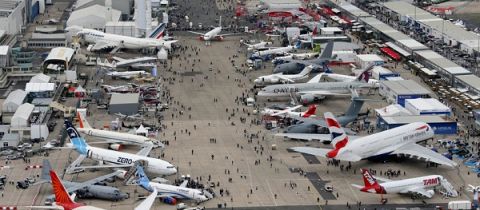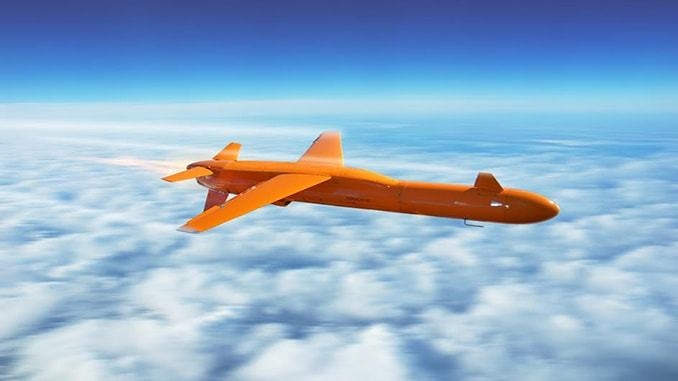

Leonardo introduces its new aerial target drone to the market at the 2017 Paris Air Show. Based on the company’s experience with its successful ‘Mirach 100/5’ target drone which has earned a place as the standard threat simulator of international Armed Forces including France, Italy and the UK, the new ‘Mirach 40’ (M-40) is designed to provide medium-to-high performance at a price comparable with competitors’ entry-level drones.
The M-40 is a remotely-piloted aerial system (RPAS) that supports Armed Forces training by simulating a range of airborne threat targets. Able to convincingly mimic a variety of aircraft and missiles, the target drone can simulate radar, infrared (IR) and visual threats. This allows Armed Forces to ‘shoot down’ the reusable M-40 in realistic scenarios, allowing them to train with and qualify a wide variety of weapon systems. Developed in-house by Leonardo using commercial components, the M-40 is readily exportable around the world.
Responding to the fact that customers worldwide increasingly need to ‘do more with less’, the M-40 builds on Leonardo’s experience with the Mirach 100/5 to offer a majority of the performance of such a model at a significantly reduced cost. The M-40 is suitable for a range of training purposes, from Ground Based Air Defence (GBAD) artillery training to the simulation of high-performance aerial threats for Navy and Air Force training. Leonardo will also continue to offer the Mirach 100/5 alongside the M-40 to simulate the highest-performance threats facing modern Air Forces. The M-40 uses the same ground control station as the Mirach 100/5, meaning that pilots need very little training to switch to the new drone and armed forces can operate mixed fleets of M-40and Mirach 100/5 drones.
Because the new M-40 inherits the flight characteristics of the proven Mirach 100/5, it comes with a versatile range of high-performance features including a low-altitude ‘sea skimming’ capability and the ability to execute high-G maneuvers, both uncommon in comparatively-priced competing systems. The refined aerodynamics of the M-40 also allows it to exceed the speed of most twin-engine systems, despite employing a single commercial, multi-fuel engine. The use of a single engine also reduces maintenance requirements and allows for easier deployment even at very remote training ranges. To ensure that M-40 is easy to store and transport, it is designed to operate without pyrotechnics, even for launch and parachute deployment.
Archived
9 years ago
Asco, a subsidiary of Montana Aerospace AG, achieves significant technological milestone in the development of a hybrid multi-material Rear Secondary Structure for Airbus. Montana Aerospace,...
Bombardier announced plans to further expand its presence across the United States, with the creation of 800 jobs supported by ongoing growth initiatives and strategic infrastructure investments. ...
Embraer reported a record backlog of US$35.7 billion in the third quarter of 2026, surpassing its previous all-time high by 3% quarter-over-quarter and increasing 14% compared with the...
Oriens Aviation has appointed Narine Melkumjan as Sales Manager for the Netherlands, strengthening its presence in the Dutch market following its designation as Tecnam’s exclusive dealer in the...