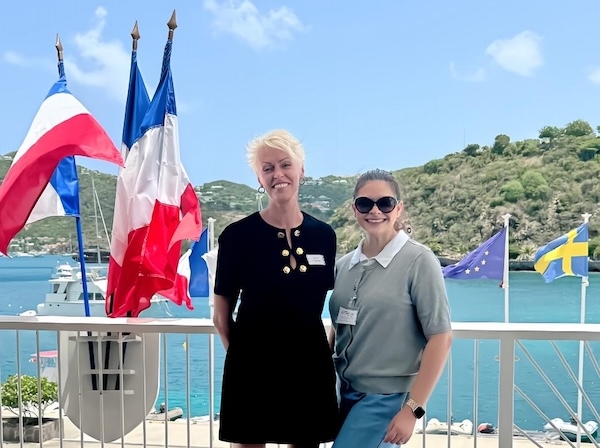
During the first day of Caribavia, a particularly important question was raised: the importance of investment in the aeronautical sector in the Caribbean. The aim of attracting investment is more than obvious - to boost economic development. The question - how? Why should this particular region be of particular interest to investors and aerospace companies?
Alicia Hackshaw's answers and suggestions were more than clear and obvious. If we have to be brief - the Caribbean region has the qualified workforce, which can be defined as valuable human capital, has the infrastructure and perhaps most importantly, has the real will to make things happen. Despite the obstacles. Flight schools, training centers, maintenance center, the choice is really wide. Apart from being a presenter who takes the audience with her, with her positive energy, knowledge of her subject and experience in the field, Alicia Hackshaw is a truly unique woman in aviation.
Alicia was the first female helicopter pilot in her country. She was a helicopter Chief Pilot for amongst other the Trinidad and Tobago Air Guard and an Offshore Senior Helicopter Captain at Bristow Helicopters. Now Alacia is a Member Board of Directors of the Trinidad and Tobago Investment Promotion Agency (TTTIPA) and Flight Operations Inspector at the Trinidad & Tobago Civil Aviation Authority.
I've had the pleasure of chatting with her, and I'd like to share the essentials with you:
T.O. So,after two days spent at Caribavia, your impression and why this event is different?
A.H. So, this is really a lot of Bud doing, getting the regional stakeholders together, which is not something that we've had before in the Caribbean. And Bud has been literally the person championing this for many years apparently. I was so amazed that he was able to get so many of our local and regional stakeholders in one place to discuss what we have to discuss.
T.O. Commander Bud, he used to say that this is event like no other Would you agree?
A.H. Oh, definitely. There's not been anything like this before.
T.O. Easy question - what is the topic in aviation you care most about and you're willing to do, moving forward something better?
A.H. So it's just like what I explained in my presentation. I would love to move aerospace manufacturing, some bigs of it into the Caribbean because there's so much aviation that happens here and there's so much money is made off of it. It's a big pie. And there is the opportunity to come down to the Caribbean. We have a workforce, we have the human capital, we have the infrastructure. It's about time that other people invested in us because I'm very certain they always say there are Caribbean people everywhere. And I'm sure in Boeing and Airbus and wherever I'm sure there are Caribbean locals working there as well.
T.O. Why it's not happening yet, do you know?
A.H. I'm not sure. I don't know if it's lack of visibility, I don't know if we are, as Caribbean people, we're not marketing ourselves properly So, this is another topic I touched on during my presentation. We, Caribbean people, tend to be very comfortable with what we've got. So we have this beautiful island, beautiful water, and then you're gonna say, well, tourism's bringing in, you know, a huge chunk of change, so why am I even going to try to do anything out of the box? But the more that you inform and empower the locals to understand that tourism is not the most sustainable enterprise. And we saw that during COVID where tourism fell, the numbers fell and it was a disaster for many economies. So, let's bring some manufacturing in, for that one. And Two, I would like to give the younger generation other opportunities. Okay. If, if my parents are in hotel hospitality management, I may want to go do something in aviation. Build something, be an engineer. And our local kids should have the opportunity at home to do that.
T.O.Do they have the right to dream about aviation? Why I'm asking. Because,in France we had one « brilliant » city mayor who cutted all the money to local aero club and who told that kids shouldn’t have right to dream about aviation anymore. I still think that it's a wonderful industry that makes people invent so many things and find the way to do so many things to become better, more sustainable or different or innovating. So do kids into Caribbean have right to dream about aviation?
A.H. Of course, of course. And we see So, in Trinidad especially we have, our University puts out a lot of engineers. The engineering faculty of our local University is huge. We pump engineers out all the time. And of course they, have a right to dream. And what I say about the younger generation, especially because I have a son who's 7 years old, they're so good at STEM. They are. Literally when he was 2, he could go around an iPad and figure it out. And they're so driven and, you know, technology makes up this massive part of their lives now. I mean, you know how much time we spend on our phones and the Internet and the iPad, it's something that is coming so second naturely to them, you know. And I've seen a lot of kids right now like robotics. We've started in Trinidad offering robotics on the curricula and it's doing so well. We have a national robotics championship now and all these schools are getting together to participate. My son is 7. He's been in robotics since he was 5. And these are the jobs of tomorrow. Yeah. So we have to prepare our kids. We have to.
T.O. You're talking about jobs of tomorrow. Do you think that all the authorities, governments on each island, do they know and do they realize that to get jobs of tomorrow, the work has to be done now? four or five years ago maybe?
A.H. Exactly, exactly. And this is why I added my presentation this week that we need to get trading academies in the Caribbean. And that's where we start. And even if it's something as small as putting an air, let's say an engine repair in the university, of course, it starts off very small like that. So Trinidad recently ran a very successful masters in aviation management. And it was so well attended, it was wonderful. And then it fell by the wayside. I'm not sure why. But we also have to remember that not everybody is a scholar. Not everybody's going to want to go to. We have people who are amazing and technical, and we are just correct. And we are not offering those, Those technical types of education.
T.O. Last question. Women in aviation. Can we do things different? Should we do things different?
A.H. Let me tell you… When I was in flight school, I flew with a crazy Cuban instructor. He was a real macho. And he was like... He'd never flown with a woman before. Never flown with a woman. When we were done, he cried. When I got my license, when I got it, but I passed my check, right? He said, woman, you fly so much better than any man I've ever flown with. Oh, my gosh. And of course, you know, Tatiana, I was the first female helicopter pilot in my country. It was very, very difficult. Breaking that glass ceiling in a very, very boys club was very, very difficult.
T.O. Industry reminds, let's say, reminds very boys club. It's very boys club. And I know that we talk a lot and we try to show that females can contribute so many things to the industry and what can change the industry for the better. But in my opinion, there is a still way to go.
A.H. Yes. To make them accept more. We're seeing the progress at home. Caribbean Airlines, for example, our national carrier. This is the most amount of female pilots that they have ever had in any period of time. When I left flying, I left four ladies behind flying helicopters. So it's small steps, but we'll get there. We will get there. And we have to empower the younger ones.
T.O Coming up what we should do to promote it more, because as you talk it's about marketing. Aviation is positionned often as a « bad » industry, especially in Europe. The bad one if we talk numbers, it's so wrong because we are not responsible for all the carbon emission in the world. It's very far from that.
A.H. Yes, but still, we have to do much more than we did before to show how we are improving this world and to market the industry for future generations. So this is why it takes people like you. Like me. Right. So let's communicate more and let's share the ideas even more than we did before. Definitely. And this is why a conference like this is so important. I've learned so much from this conference already. And then I met Commander Bad. I met you because I've already always loved your magazine, your publication. So I finally got to meet you.
T.O. Thank you so much. And see you at next Caribavia !
A.H. Definitely. Thank you so much. Thank you.
Archived
1 year ago
Embraer reported a record backlog of US$35.7 billion in the third quarter of 2026, surpassing its previous all-time high by 3% quarter-over-quarter and increasing 14% compared with the...
PAL-V has appointed Nobleo Manufacturing as its strategic industrialisation partner for the world’s first FlyDrive production facility. Following the achievement of both automotive and aviation...
Emirates will introduce its latest-generation Airbus A350 on the Dubai-Mauritius route from 1 November 2026, replacing the Boeing 777 currently operating the carrier’s daily EK709/710 service.&n...
Lufthansa Technik Engine Services (LTES) is significantly expanding its engine maintenance capabilities in Tulsa, Oklahoma, nearly doubling its operational capacity as part of its growth strategy acro...