



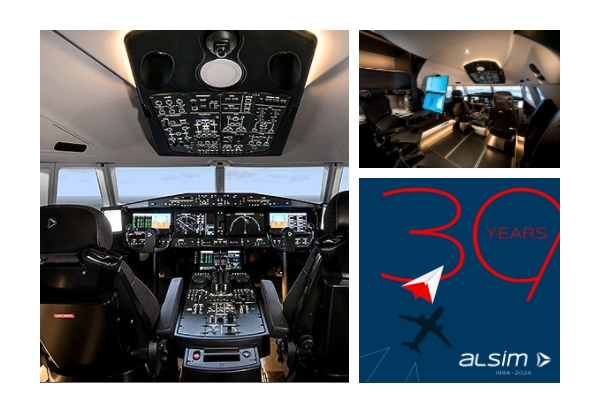
ALSIM celebrates its 30-year journey. French-based manufacturer established itself as a prime developer and manufacturer of FAA and EASA certified FNPTII, FNPTII MCC, and AATD flight simulators. Over those three decades it has built up a global reach extending to more than 400 customers and has already delivered more than 450 certified simulators across 60 countries. The journey began in 1994 with a visionary concept of creating and offering state-of-the-art flight training devices at affordable prices. The objective was clear; to develop a versatile simulator that could be utilized for various aircraft types, while keeping costs within reach of even the smallest flight schools. This idea led to a continuous stream of innovative products, beginning with the introduction of TFT screens on simulators in 1997—an industry first pioneered by ALSIM.
Jean-Paul Monnin, President and CEO of ALSIM declares: "We are delighted to celebrate our 30th anniversary. Over the years, ALSIM has remained committed to providing cutting-edge flight simulators that enhance pilot training across the globe. We are grateful for the continued trust and support from our customers and partners.”
Recognizing the growing importance of multi-crew cooperation in the airline industry towards the end of the last century, ALSIM responded by developing a simulator exclusively designed to enhance pilot confidence and competence in a multi-crew working environment. In 1999 the company achieved a milestone with the sale of its first MCC trainer, laying the foundation for future innovations.
In the early 2000s, Diamond Aircraft emerged as a leading innovative player in the aviation training market. ALSIM promptly responded and, working closely with the OEM, successfully launched the AL42 in 2005—a faithful replica of the Diamond DA42 twin-engine training aircraft. Dedicated to their continuous quest for innovation and improvement, the ALSIM research and development team then conceived and manufactured an entirely new device which can replicate ten different aircraft models, thereby providing training capabilities from PPL up to MCC/JOC. Thus, the remarkable ALX was born and introduced in 2008.
In early 2016, ALSIM revisited its founding principle of creating cost-effective, versatile flight training devices, resulting in the creation of the AL250—a compact simulator adaptable for SEP/MEP training on the PPL, CPL, and IR/ME levels. Just a year later, in 2017, ALSIM unveiled their second type-specific device for a classic training aircraft, the Cessna 172 Skyhawk.
Innovation is very strongly embedded in the DNA, and in 2020 further evidence of that was shown when ALSIM was proudly presented their latest achievements - "The Airliner" and the brand-new ALSR20—an exact replica of the Cirrus SR20 aircraft. "The Airliner" is a multi-purpose hybrid (B737/A320) simulator, designed to cater to the demands of advanced MCC and APS MCC training as delivered by medium to large ATOs. A partnership with Cirrus Aircraft also ensures that the ALSR20 matches the ongoing evolution of the aircraft.
Rising production rates and the launch of new aircraft programs are driving increased demand for manufacturing capacity across the aerospace industry. To support this growth, FACC plans to i...
Dutch flag carrier KLM, part of the Air France-KLM Group, has welcomed its first Airbus A350-900, marking a significant step in the airline’s long-haul fleet modernization strategy. The arrival...
TRU Simulation + Training Inc. will showcase its Veris Virtual Reality Flight Training Device (FTD) for the Cessna Skyhawk at NBAA-BACE 2026, marking the simulator's first appearance at the indust...
Boeing and Ethiopian Airlines have announced a new cargo fleet expansion agreement, with the African carrier ordering eight 777-8 Freighters and two additional 777 Freighters. The investment will enab...

