



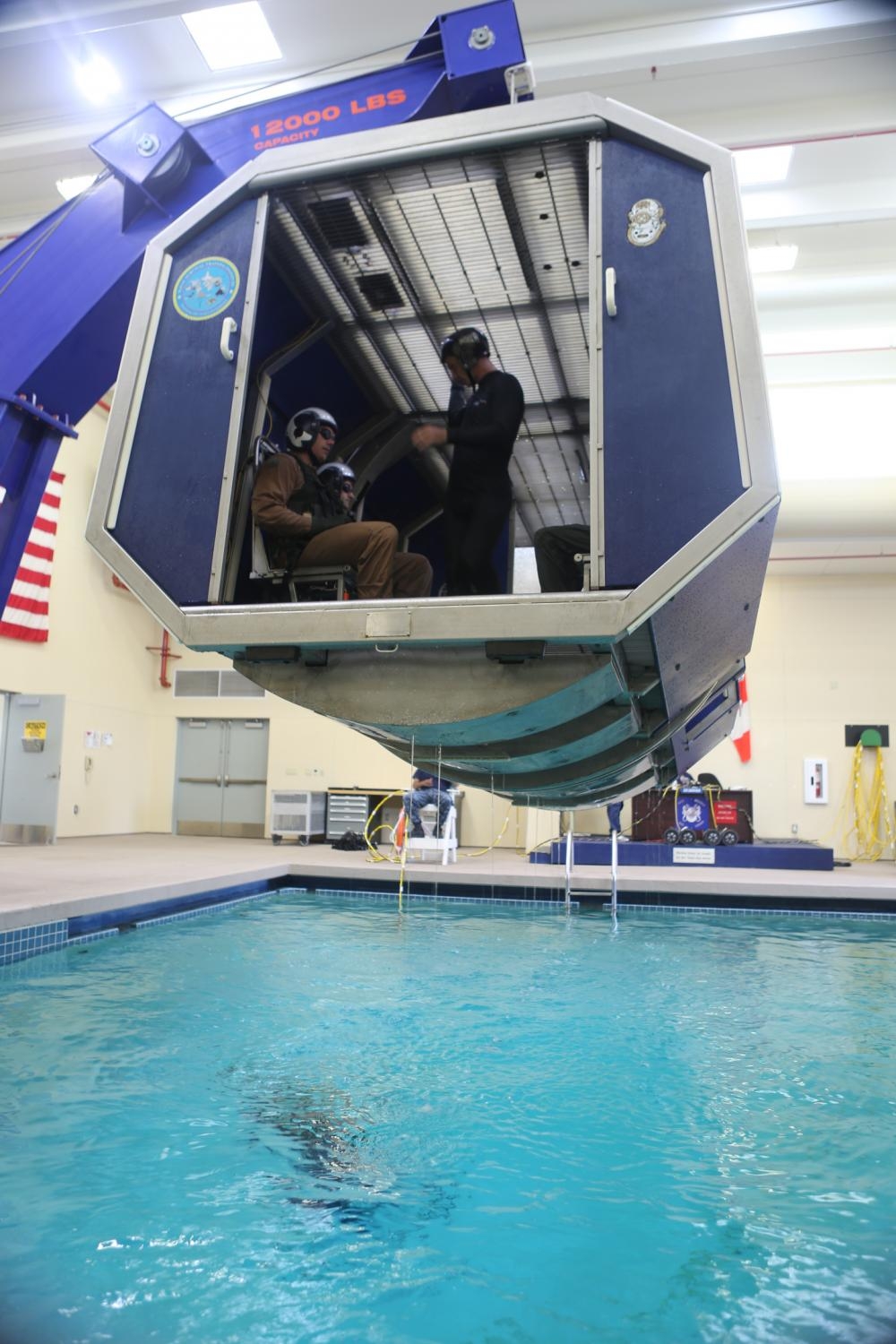
Instructors circle the pool keeping a close eye on the students in the water. The students swim to the deep end of the pool and float, waiting for instructions.
“INFLATE! INFLATE!” the instructors yell.
The students fumble in the water, trying to insert the mouth piece and blow up the orally- inflatable back-up equipment around their necks under the pressure.
One student starts to panic and begins sinking, struggling to stay above the water. A safety diver throws him a red buoy and helps him out of the pool.
After calming down, they send him back in and he continues training.
This practice is common at the Aviation Water Survival Training center aboard Marine Corps Air Station Miramar, California.
“Anytime we have someone that is panicking, we’ll pull them aside and start working with them a little bit, at a slower pace,” said Petty Officer 1st Class Brandon McMahan, an instructor with the Aviation Water Survival Training Center aboard MCAS Miramar and a West Palm Beach, Florida, native. “Our purpose here is not to push as many students through as possible; it is to build confidence and to establish muscle memory.”
The purpose of Aviation Water Survival Training is to put the students through the worst- case scenario; simulating what they should do if they are aboard an aircraft that goes down over water, according to McMahan.
First, the students warm up and swim 50 yards wearing regular swimwear before they put on their flight equipment. They practice floating exercises putting on full flight equipment.
“We require them to swim 50 yards and then do an oral inflation as if their equipment would have failed,” said McMahan. “Once they have demonstrated their aviation water survival skills in flight equipment, then we start working on their underwater problem solving skills.”
After the swim, the students sit in the Modular Shallow Water Egress Trainer. The M-SWET trains them to grab a hold of something for a point of reference, before they release their seat belt.
“The hardest part is getting the steps down, as the checklist prescribes,” said Petty Officer 2nd Class Thomas Williams, an aviation water survival training student attending the class on Thursday, Dec. 3. “We always announce it but it’s different going through the motions, so it’s good to actually get out here and do the steps physically.”
The M-SWET resembles a segment of a helicopter, with just a seat, a wall and a window. The student straps in, while instructors on either side grab the handles and prepare to flip the student underwater.
“Brace for impact,” the instructors yell.
The instructors then completely submerge the student by rotating the M-SWET 180 degrees.
This disorients them and prepares them for the helicopter dunker, according to McMahan.
Next, the students learn life raft organizational skills for extended sea stay survival.
“We talk about all the things that they would need to do,” said McMahan. “[This includes] assigning jobs such as people on look out, signaling devices, what they can eat and what they can drink.”
The pilots then take turns leaving the raft, and swim to the helicopter hoist simulator.
The simulator sprays water in all directions simulating rotor wash from helicopter rotors, while the student swims to the hoist in the midst of the water. The student must remain calm and successfully hook themselves to the hoist. It lifts them to the top of the platform, simulating a helicopter flying away from the water.
Finally, the students are ready for the helicopter dunker.
The helo-dunker is a modular helicopter frame suspended above a pool. It seats two pilots, and eight passengers. The students buckle themselves into the helo-dunker as it is raised into the air. Next, they brace for impact as the helo-dunker lowers into the water and flips upside down, simulating a helicopter crash.
“We put them in the helicopter dunker with all the skills they’ve learned,” said McMahan. “They have five rounds in the dunker,”
After the long day of training is over, these pilots will not have to see this training center again for a while.
“This is a refresher course,” said Williams. “You do it every four years. It’s important to the instructors that every student feels confident before they go out because they don’t have to take this course again for another four years.”
The students leave the pool tired and soaking wet, but with valuable new skills.
“There are first-hand accounts of people that have used this training and survived,” said Williams. “So it works.”
FL Technics Indonesia, the first MRO in Indonesia to be appointed as a GE Aerospace avionics support partner, has signed a service support agreement with GE Aerospace covering Boeing 737 and Airbus A3...
Etihad Airways has signed an interline agreement with Nigerian airline Ibom Air, enabling travellers to connect seamlessly beyond Lagos and Accra to five destinations across Nigeria on a single t...
UH-60 Black Hawk helicopters operated by Helicopter Alliance played a vital role in combating wildfires across Central and Southern Europe during the aerial firefighting season that has now concluded....
Tecnam introduces the P2008JC NG to the United States market, bringing flight schools a certified, next-generation training aircraft designed to dramatically reduce operating costs while maximizing fl...

