



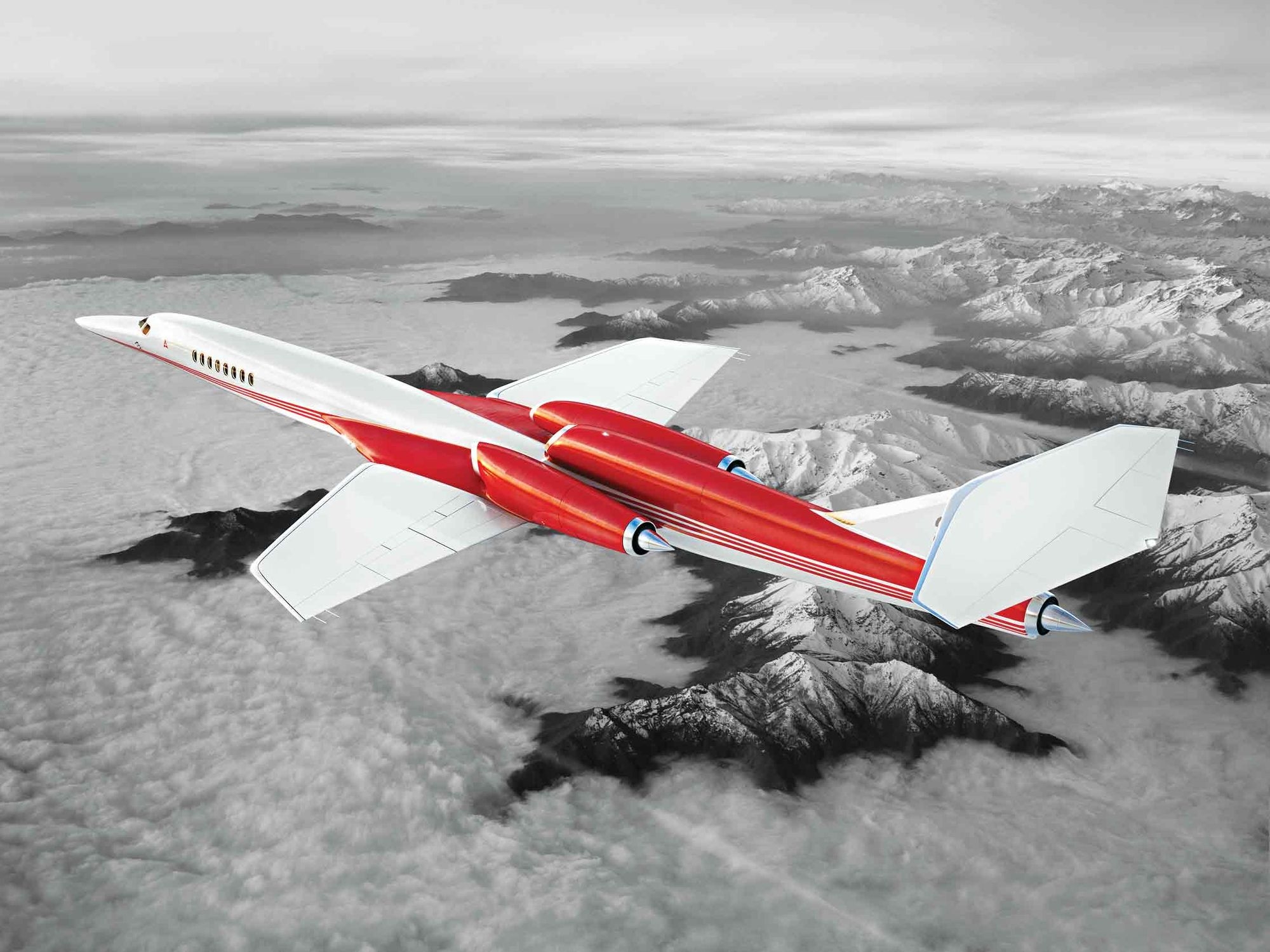
Until its retirement 13 years ago, the supersonic Concorde was plagued by two major problems: inefficiency and noise (the sonic booms it produced got it banned from over-land cruising). Now, heavyweights like Virgin and Airbus are planning to tackle supersonic speeds, and NASA began designing a “low boom” supersonic jet this year. But no one is as close as aircraft manufacturer Aerion Corporation, which is developing the AS2.
Quiet Cruise
When air molecules slam into a supersonic jet, they create a high-pressure wake that reaches the ground as a startling “ba-boom.” By slowing down its cruise speed to Mach 1.2 (the Concorde’s was Mach 2), the AS2’s wake will dissipate before it reaches civilization.
Straight and Carbon-Strong Wings
Typical supersonic wings sweep back to create a triangular shape. That design creates lift—but also drag-producing air eddies toward the back of the wings. The AS2’s wings jut straight out from the fuselage and, thanks to ultrastrong carbon fiber, have a thinner contour. This lets air travel in straighter lines, reducing overall drag by about 20 percent.
Pinch Point
The AS2’s 170-foot-long fuselage pinches in at the wings, creating an elongated Coke-bottle shape. This allows for smoother airflow around the body while still providing room in the cabin for passengers and crew.
Off-the-Shelf Engines
Instead of building expensive custom engines, Aerion plans to adapt commercially available ones for supersonic flight. The engineers will reduce the diameters of the big engines’ fans so their sound at takeoff and landing will meet airport noise standards—without losing the power needed to achieve supersonic flight.
Bombardier Challenger 3500 will be on display at LABACE 2026 at Campo de Marte Airport in São Paulo, revealing its impressive design and performance attributes for clients in region.&...
Volatus Aerospace announced the next phase of its national wildfire response initiative through a strategic partnership with Singular Aircraft, developer of the FlyOx 1 multi-mission heavy-lift autono...
U.S. Federal Aviation Administration has granted Boeing an amended type certificate for the new 737-7 airplane, clearing it for commercial service. The smallest...
Eve Air Mobility completed its first partial transition flight, marking an important milestone in the development and testing of the company' eVTOL aircraft. The flight involved the acti...

