



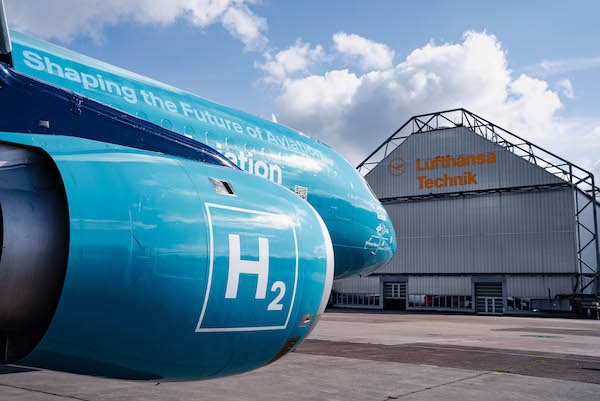
A decommissioned Airbus A320 is being given a new lease of life in the service of science. The Hydrogen Aviation Lab, Hamburg's new field laboratory for testing maintenance and ground processes for future hydrogen-powered aircraft, was unveiled. Hamburg's Senator for Economic Affairs Michael Westhagemann – whose ministry funded the joint project between Lufthansa Technik, the German Aerospace Center, the ZAL Center for Applied Aeronautical Research and Hamburg Airport – inspected the repurposed Airbus A320. The presentation of the Hydrogen Aviation Lab also marks the start of the installation of the hydrogen components in the coming months.
The aviation industry is striving to become climate-neutral, with hydrogen widely expected to play a role as a future energy carrier. This requires not only new aircraft but also new infrastructure on the ground. Hamburg is forging a path towards such a hydrogen infrastructure: Lufthansa Technik, DLR, ZAL and Hamburg Airport have joined forces to design and test maintenance and ground-based processes for hydrogen technology. The project is funded by Hamburg's Ministry of Economic Affairs and Innovation as well as the city's investment and development bank (IFB Hamburg).

The project has reached a new milestone. Lufthansa Technik has prepared the aircraft – which flew for Lufthansa Group for 30 years as "Halle an der Saale" – for its crucial next stage. Over the next few months, the Hydrogen Aviation Lab will be fitted with a full suite of test systems as well as an internal tank for liquid hydrogen and an onboard fuel cell, paired with supporting ground-based hydrogen infrastructure.
Lufthansa Technik CEO Soeren Stark, DLR Executive Board Chairwoman Anke Kaysser-Pyzalla, ZAL Managing Director Roland Gerhards and Michael Eggenschwiler, CEO Hamburg Airport, met with Senator Westhagemann to have a close look at the new laboratory and to provide insights into its design and project focus. While this Airbus A320 will no longer be taking to the skies, it is capable of being towed to locations at the Lufthansa Technik base and Hamburg Airport to enable real-world research of ground-based processes.

Senator Michael Westhagemann commented: "With the Hydrogen Aviation Lab, Hamburg has embarked on a great project. It will make a valuable contribution to enabling the use of hydrogen as a fuel for aviation. The focus on maintenance and refuelling procedures should provide us with insights that will be important for developing hydrogen infrastructure. This real-world lab lets us add a crucial building block to Hamburg's strategy to make aviation more sustainable. We are following two strategic goals: the development of a hydrogen economy in Hamburg and the decarbonisation of the mobility industries. We are very pleased to be able to make this world-first project possible through the Special Aviation Fund."
With the Hydrogen Aviation Lab, the project partners want to prepare for handling and maintenance of hydrogen-powered aircraft, whose entry into service is forecast for the middle of the next decade. Yet the laboratory will also spur on developers of future hydrogen-powered aircraft generations by helping optimise the procedures and safety levels during maintenance work or ground-handling.
A particularly striking example is refuelling with liquid hydrogen (Liquid H2, or LH2 for short). Using current technology, the refuelling for a long-haul flight could possibly take several hours. Given the pressure on aircraft turnaround times in the airline industry, this would be clearly impracticable. The Hydrogen Aviation Lab is designed to address this and many other areas of research (see examples below).
Main research topics and central questions in the Hydrogen Aviation Lab
Refuelling with liquid hydrogen:
Cooling, insulation and occupational safety:
Leakage of hydrogen gas, so-called „Boil-Off":
Making stored hydrogen inert:
Parallel to research carried out using the physical hardware of the Hydrogen Aviation Lab, the project also involves the creation of a so-called digital twin of the Airbus A320. Therein, simulations will enable researchers to develop and test predictive maintenance methods for the systems and components of future aircraft generations. Using targeted data analyses, failures of hydrogen components and systems could thus be predicted ahead of their failure in the physical system, allowing timely replacements before component failures affect aircraft operation.

PAL-V has appointed Nobleo Manufacturing as its strategic industrialisation partner for the world’s first FlyDrive production facility. Following the achievement of both automotive and aviation...
Archer Aviation has unveiled plans to develop three air taxi networks across Austin, Dallas-Fort Worth and Houston, aiming to improve connectivity between major airports, business centers and key regi...
Confidence among the world’s leading accredited aircraft dealers strengthened in the third quarter of 2026, reflecting continued momentum in the preowned business aviation market. According to t...
Bombardier announced plans to further expand its presence across the United States, with the creation of 800 jobs supported by ongoing growth initiatives and strategic infrastructure investments. ...

