



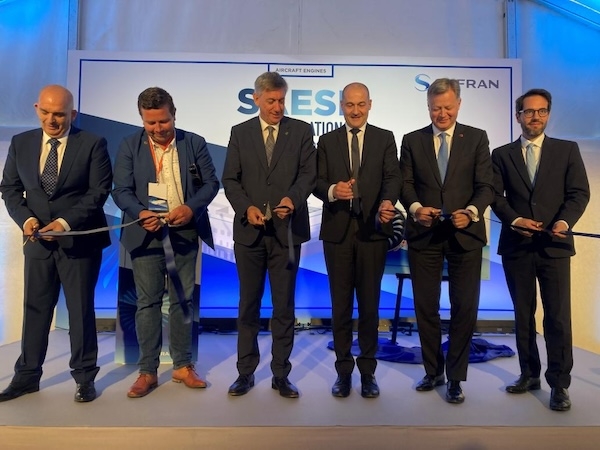
Safran Aircraft Engine Services Brussels opened a new MRO workshop for LEAP engines in the Brussels airport zone. Safran Aircraft Engines has invested €24 million in the construction of the 8,500-square-meter workshop, which will round out its global MRO network and support the ramp-up of LEAP services activities. The majority of aircraft in the new-generation A320neo and B737 MAX single-aisle families are powered by LEAP-1A and LEAP-1B engines. The new site boosts Safran Aircraft Engine Services Brussels’ existing capability, which was established within the Brussels Airport Company ecosystem almost 25 years ago.
Safran Aircraft Engines CEO Jean-Paul Alary commented: “We are delighted to expand our industrial footprint in the Brussels airport ecosystem, which offers a top-notch blend of skills and low-carbon infrastructure. This new site is a vital link in our global MRO network, helping to support the growing fleet of LEAP engines around the world while reducing our environmental footprint.”
Arnaud Feist, CEO of Brussels Airport, said: “This ultra-modern construction marks an important milestone in our partnership with Safran, underlining our commitment to providing world-class infrastructure and services. With advanced energy-efficient technologies and sustainable design, this new facility not only improves operational efficiency, but also reflects our commitment to a sustainable future.”
Nicolas Potier, Vice President Support and Services at Safran Aircraft Engines stated: “We’re already working on an extension which will allow us to switch the maintenance of LEAP engine modules to the new workshop by the end of the decade, the aim being to reach a capacity of over 1200 modules per year. This activity is currently handled by our historic facility. This ramp-up in our engine and modules activities is underpinned by an ambitious plan to recruit more than 220 people, which will boost SAESB’s total headcount to 470 by 2027.”

Safran Aircraft Engine Services Brussels was the first workshop in the world to be certified for maintenance of the LEAP-1A model, in 2016. Now with more than 75 years’ experience in MRO for aircraft engines, the firm kicked off operations in the new facility this year, and ultimately aims to ramp up its throughput to 120 shop visits annually. The new shop is also designed to the best environmental standards, and will be carbon-neutral thanks to its use of 100% renewable energy, with solar panels on the roof, and circular heating systems.
The LEAP engine is a major commercial success, with over 7,500 units already in operation, totaling more than 50 million flight hours, and an order backlog that tops 10,600 units. In service some 150 operators around the world, the new-generation engine offers 15–20% reductions in fuel burn and CO2 emissions, and delivers significant improvements in noise levels compared with previous- 2 generation models. The LEAP engine was developed by CFM International, a 50/50 joint venture between Safran Aircraft Engines (France) and GE Aerospace (United States).
Lufthansa Technik Engine Services (LTES) is significantly expanding its engine maintenance capabilities in Tulsa, Oklahoma, nearly doubling its operational capacity as part of its growth strategy acro...
Asco, a subsidiary of Montana Aerospace AG, achieves significant technological milestone in the development of a hybrid multi-material Rear Secondary Structure for Airbus. Montana Aerospace,...
Oriens Aviation has appointed Narine Melkumjan as Sales Manager for the Netherlands, strengthening its presence in the Dutch market following its designation as Tecnam’s exclusive dealer in the...
Affinity Aviation Group (AAG), a leading provider of business aircraft sales, acquisitions and charter solutions, has entered into a strategic collaboration with Austria’s AeronautX, reinforcing...

