



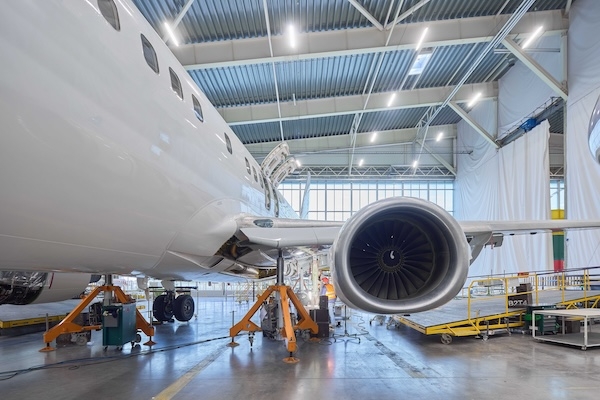
For airlines, every additional day an aircraft remains on the ground during heavy maintenance directly impacts operations, schedules, and revenue. As maintenance workloads become more complex and turnaround time pressure continues to increase across the aviation industry, MRO providers are facing growing expectations to complete checks faster without compromising quality or safety. According to aviation consultancy IBA, aircraft grounding costs for airlines can reach up to USD 150,000 per day depending on aircraft type and operational disruption.
While planned C and D checks are already among the most expensive maintenance events in an aircraft’s lifecycle, unexpected findings, delayed inspections, material shortages, or additional repair requirements can quickly extend downtime and create significant operational costs for airlines.
According to Juozas Lapeika, Chief Base Maintenance Officer at FL Technics, minimizing maintenance downtime depends heavily on how quickly MRO providers can identify problems, make technical decisions, and complete repairs without unnecessary process interruptions: “Today, airlines are not only looking for maintenance quality – they are looking for predictability and speed. Every unnecessary delay during heavy maintenance creates operational pressure for the customer. That is why investment in inspection and diagnostic capabilities has become a critical part of maintaining predictable turnaround times.”
One of the most time-sensitive areas during base maintenance involves fuel system inspections and repairs. Fuel leaks are among the issues that can significantly affect maintenance timelines, particularly if they are discovered late in the process.
In some cases, fuel leaks are only identified during the final stages of maintenance testing, after fuel has been loaded back into the aircraft. If a leak is identified at that stage, the process becomes highly time-consuming. Fuel must be drained again, tanks ventilated and dried before technicians can re-enter the area for additional repairs and repeat testing. In some cases, this can extend turnaround time by several days.
One way to reduce this risk is to use helium-based fuel leak detection during maintenance processes before aircraft refueling and final testing stages. This allows technicians to identify potential leak points earlier and avoid repeated maintenance cycles caused by leaks discovered only after fuel loading.

“The biggest advantage is avoiding repeated maintenance cycles,” explained Lapeika. “In the past, leaks discovered only after refueling could extend maintenance timelines by several additional days. Earlier detection helps avoid that disruption and, in certain maintenance scenarios, can reduce turnaround time by four to five days.”
While fuel leak detection helps prevent delays during the final stages of maintenance, inspection capabilities can be equally important earlier in the maintenance process. During heavy maintenance checks, structural inspections may require radiographic testing to assess potential hidden defects or internal damage within aircraft structures. When such capabilities are not immediately available in-house, additional time may be lost coordinating equipment availability, transportation, or external inspection support.
“Non-routine findings are one of the biggest variables affecting heavy maintenance timelines,” said Lapeika. “The faster you can inspect, assess, and make repair decisions, the better control you maintain over turnaround time. Having these capabilities available in-house allows us to respond faster and avoid unnecessary delays.”
According to him, investments in inspection technology are no longer simply technical upgrades for MRO providers. They are increasingly becoming operational tools that help airlines reduce downtime, improve maintenance planning predictability, and minimize disruption to fleet operations.
“We are not investing in equipment to make maintenance look more advanced,” Lapeika added. “We invest because faster diagnostics, faster inspections, and faster decision-making directly help reduce aircraft downtime for our customers.”
As airlines continue pushing for shorter maintenance windows and greater operational flexibility, the ability to minimize non-routine delays is becoming an increasingly important differentiator across the heavy maintenance sector.
Boeing and Ethiopian Airlines have announced a new cargo fleet expansion agreement, with the African carrier ordering eight 777-8 Freighters and two additional 777 Freighters. The investment will enab...
Etihad Airways has signed an interline agreement with Nigerian airline Ibom Air, enabling travellers to connect seamlessly beyond Lagos and Accra to five destinations across Nigeria on a single t...
PAL-V has signed a Memorandum of Understanding with AVION, a specialist in advanced flight training devices, and FLYVE, a developer of FlyDrive ecosystems for professional and government operator...
British Airways has unveiled the next phase of its Heathrow lounge transformation programme, marking the beginning of a significant investment aimed at modernising every lounge across the airport in t...

