



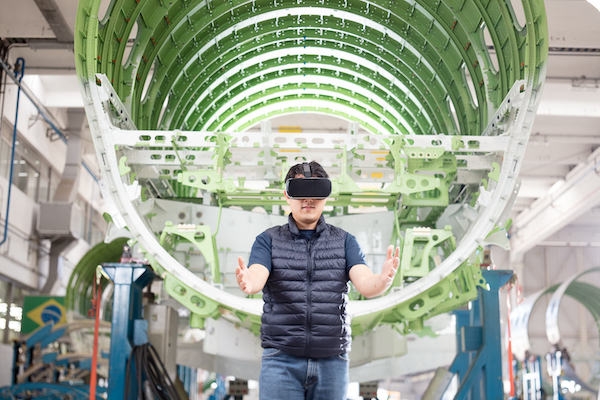
Embraer, ITA (Technological Institute of Aeronautics), and FAPESP (São Paulo Research Foundation) announced yesterday the approval of a joint investment of R$ 48 million in an Engineering Research Center (ERC) for the future of air mobility over the next five years.
This unprecedented research in Brazil will gather representatives of the scientific community and professionals of the aeronautical industry in activities that are based on three pillars: low carbon aviation, autonomous systems and advanced manufacturing. The initiative creates a favorable environment for knowledge dissemination, highly qualified human resources training and production of high-impact scientific publications.
“We are very excited with the approval of the Engineering Research Center focused on the future of air mobility, in partnership with ITA and FAPESP,” said Luís Carlos Affonso, Embraer’s Senior Vice President of Engineering, Technology, and Strategy. “I am certain that the Center will be a benchmark of enterprise-government-academia cooperation toward the zero-carbon aviation of the future, generating value to society as a whole.”
“The partnership among FAPESP, Embraer and ITA will certainly be fruitful and will offer an answer to a great challenge that will be faced by the research in the next years: the transition to a low carbon economy associated with advanced manufacturing,” said FAPESP President, Marco Antonio Zago.
“ITA was created in the triple helix model, as an intersection of academia, government and industry,” said the Dean of ITA, Anderson Correia. “This initiative is another icon of this model, which will expand the training of human resources in strategic areas for Embraer, FAB and the sector's production chain. It will also promote international integration to meet the challenges of the future of air mobility.”
Over the last few months, the institutions described the research and the main activities scope to materialize this partnership, which proposed innovative technological solutions that will maximize the competitiveness in the global innovation ecosystem.
Partnerships as the ERC guide and enable the conditions for the technology’s transfer among industry players, stakeholders and the third sector, and strengthen connections and innovations through partnership models and intellectual property management. These partnerships also generate new business incubation and stimulation of entrepreneurial activity in which the research results are applied.
Emirates has officially inaugurated services to Helsinki, marking a significant milestone in connectivity between Finland and the United Arab Emirates. The new daily route is the only year-r...
British Airways has unveiled the next phase of its Heathrow lounge transformation programme, marking the beginning of a significant investment aimed at modernising every lounge across the airport in t...
UH-60 Black Hawk helicopters operated by Helicopter Alliance played a vital role in combating wildfires across Central and Southern Europe during the aerial firefighting season that has now concluded....
As the first aviation company in Kansas to introduce state-registered youth apprenticeships through the Kansas Office of Apprenticeships, Textron Aviation is taking a leading role in workforce develop...

