



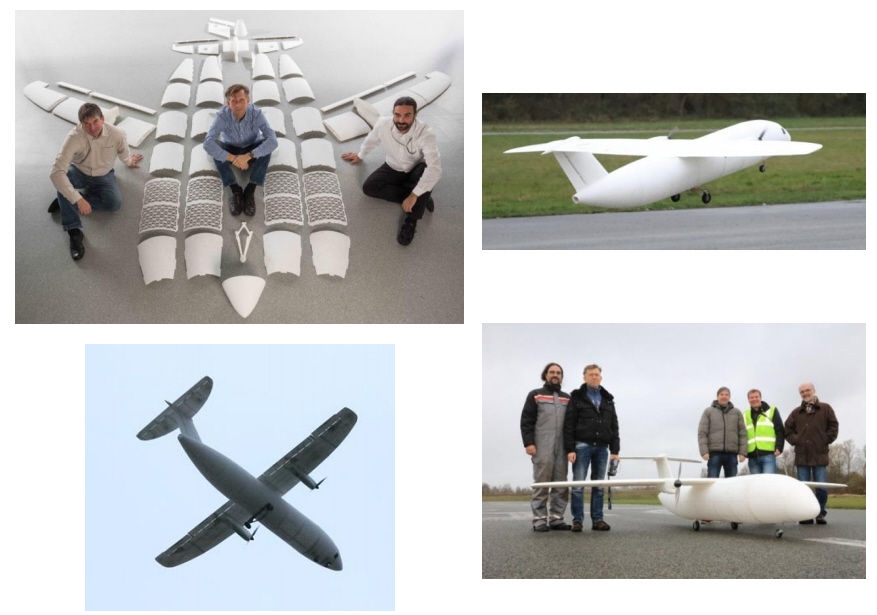
Airbus, the European aerospace giant, has a new drone named Thor. Thor is a clumsy acronym for “Test of High-tech Objectives in Reality,” and what the drone does is nowhere near is important as what it means. The drone, all 13 feet and 55 pounds of it, was 3D printed over the course of about a month.
Unveiled at the 2016 International Aerospace Exhibition and Air Show in Berlin this week, Thor is made of roughly 50 3D printed parts. It is easier to name what in Thor wasn’t printed: some parts of the two engines, and the controls.
Thor had a first successful flight back in November, where it flew for 25 miles. Airbus plans 18 more test missions this year for the aircraft. Should any part break, 3D printing makes replacement easy, and if any part can be improved, it’s easy to print the part to the plane’s design and replace it. It’s the flexibility of 3D printing that Airbus hopes to capitalize on, and regardless of whether or not Thor is useful as an independent product, it’s teaching Airbus engineers what they can do with 3D printed planes. A rough draft of the future, in miniature form.
flyadeal, the fast-growing low-cost carrier of Saudia Group and one of the GCC's largest budget airlines, has expanded its presence in India with the launch of non-stop flights between Riyadh and...
Tecnam has announced a landmark strategic partnership aimed at accelerating the growth of its P2012 aircraft family across the United States. Under the agreement, Finnoff has been appointed the exclus...
FL Technics Indonesia, the first MRO in Indonesia to be appointed as a GE Aerospace avionics support partner, has signed a service support agreement with GE Aerospace covering Boeing 737 and Airbus A3...
PAL-V has signed a Memorandum of Understanding with AVION, a specialist in advanced flight training devices, and FLYVE, a developer of FlyDrive ecosystems for professional and government operator...

