



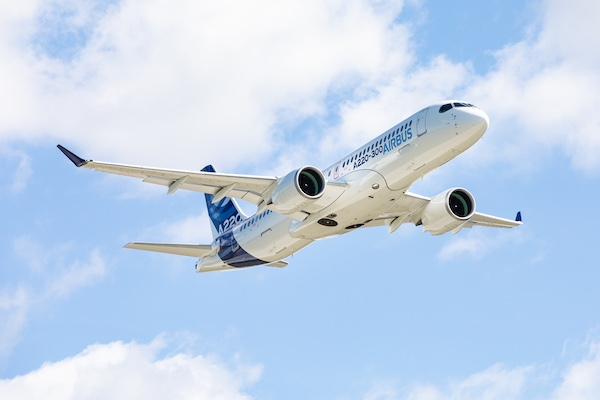
Airbus Canada, Pratt & Whitney Canada and SAF+ Consortium announced a new initiative to collaborate on next-generation sustainable aviation fuel, supported by the Government of Quebec. Known as CADAQ-100, the project will contribute to the industry-wide effort to achieve net-zero CO2 emissions for aviation by 2050, as outlined by Air Transport Action Group and IATA in their decarbonization roadmaps. Key areas of collaboration include SAF research and testing, including flight testing blends of up to 100% SAF on an Airbus A220 aircraft powered by Pratt & Whitney GTF engines. The project will also comprise feasibility studies for establishing local production facilities for power-to-liquid e-SAF in Quebec.
Benoît Schultz, President and CEO of Airbus Canada, commented: "Airbus, alongside many of its customers, is fully committed to expanding the use of SAF, an essential pillar to support the aviation industry's decarbonization journey. Building this new Canadian ecosystem alongside the SAF+ Consortium is a key milestone and example of how Airbus is actively shaping decarbonization discussions in Québec and Canada while demonstrating our commitment to making SAF an economically viable solution available to our customers and partners globally. While the A220 already offers the smallest carbon footprint for any single-aisle aircraft flying today, achieving readiness to operate with 100% SAF will help ensure the A220’s sustainability and competitiveness well into the future."
The parties will provide a total financial contribution of more than CA $17 million, supported by the Government of Québec as part of the collaborative and mobilizing projects on the development of new technologies related to the aircraft of tomorrow.
"Quebec's aerospace industry stands out for its ability to innovate, particularly in the area of sustainable mobility. Through these mobilizing projects, we are taking a step further toward making the aircraft of tomorrow a reality and thus reducing GHG emissions in Québec and internationally," said Pierre Fitzgibbon, Minister of the Economy, Innovation and Energy, Minister responsible for Regional Economic Development and Minister responsible for the Metropolis and the Montréal Region.
Jean Paquin, President and CEO of SAF+ Consortium, said: “This collaboration will help accelerate our vision to transform Montreal into a North American sustainable aviation hub, something which we have always known could only be achieved as a cross-industry effort. With multiple purchase commitments from Canadian airlines in place, alongside our ambition to achieve net-zero emissions, investment in SAF production infrastructure is urgently needed.”
The collaboration will assess the feasibility of developing a commercial e-SAF plant in Quebec, targeting an annual output of up to 100 million liters of e-SAF by 2028. e-SAF would be produced using power-to-liquid technology, using renewable energy to synthesize captured CO2 emissions with green hydrogen, producing a clean aviation fuel with a potential reduction in lifecycle CO2 emissions by up to 90% compared to conventional kerosene.
Edward Hoskin, vice president of Engineering, Pratt & Whitney Canada, stated:“SAF represents a key drop-in solution for reducing the environmental impact of thousands of aircraft flying today and in the coming decades, and thereby enables the goal of net-zero emissions by 2050. Collaboration between public and private sectors is critical to achieving our goals, so we welcome this opportunity and the continued support of the Government of Quebec to help expand SAF research and production capabilities in the region.”
Typical feedstocks used to make SAF include used cooking oil, animal waste fat, solid waste from homes and businesses, and forestry waste. Today, all Airbus aircraft and all modern Pratt & Whitney engines are compatible with SAF blended up to 50% with conventional Jet Fuel-A, and work is underway to validate compatibility up to 100% SAF. Airbus Canada draws on the expertise of Airbus that aims to have all its commercial and military aircraft and helicopters be capable of operating with 100% SAF by 2030.

UH-60 Black Hawk helicopters operated by Helicopter Alliance played a vital role in combating wildfires across Central and Southern Europe during the aerial firefighting season that has now concluded....
Dutch flag carrier KLM, part of the Air France-KLM Group, has welcomed its first Airbus A350-900, marking a significant step in the airline’s long-haul fleet modernization strategy. The arrival...
TRU Simulation + Training Inc. will showcase its Veris Virtual Reality Flight Training Device (FTD) for the Cessna Skyhawk at NBAA-BACE 2026, marking the simulator's first appearance at the indust...
A new travel industry coalition is urging EU policymakers to adopt a balanced and proportionate approach to biometric travel, ensuring passengers can benefit from secure and seamless journeys while ma...

