

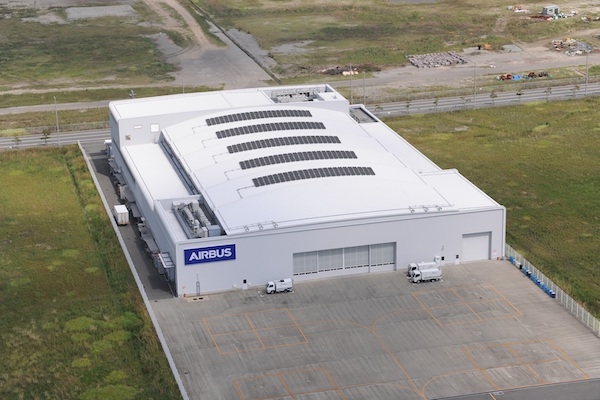
Riding on its growing business, Airbus Helicopters will be adding a maintenance, repair and overhaul (MRO) complex adjacent to its existing facility in the Kobe Airport Facility in Japan. Construction will commence in June 2019, with the new facility expected to be operational in November 2019.
The company’s existing facility is capable of accommodating up to 25 medium-sized helicopters simultaneously. It also houses its regional engineering hub and the country’s first and only helicopter full motion full-flight simulator, which has trained over 500 pilots and engineers in Japan and across the region.
With this expansion, Airbus Helicopters will have the largest footprint in the aviation business sector of the Kobe Airport Facility, occupying a total space of 19,685 sqm. Its overall capacity will increase by 60% to handle about 40 medium-sized helicopters at one time. The new building will feature a state-of-the-art hangar, an administration office, and a purpose-built warehouse.
“Japan is an important market for Airbus Helicopters. This additional facility is part of our growth plan in the country and demonstrates our commitment to strengthening our support for our customers’ fleets while responding to their increasing demand for aftersale support services,” said Olivier Tillier, Managing Director of Airbus Helicopters Japan. “We have been building up our capabilities in Kobe over the years and believe the site offers a lot of growth potential. With a larger capacity, we will be able to offer our complete suite of support and services to our customers, spanning after-sales customer support, MRO, engineering, technical support, simulator training and warehousing.”
Since the delivery of the first Alouette II helicopter to Mitsuya Air Service in 1961, Airbus Helicopters Japan has delivered more than 440 helicopters to operators and customers in the country for various missions across market segments. Currently leading the Japanese civil and parapublic market with a 54% market share, the company plans to strengthen its market position in tandem with Japan’s projected fleet growth of 2% annually over the next two decades. It has already secured 50% of the country’s new bookings for 2018.
A professional training device such as the new PC-12 PRO simulator is built on flight data supplied and validated by Pilatus. Drawing on actual flight-test and performance data, it accurately reproduc...
The Tennessee Valley Authority is demonstrating the real-world value of the Tecnam P2012 Special Mission Platform (SMP), which has become a vital tool for monitoring and maintaining its...
Cirrus Aircraft has broken ground on a new 15,000-square-foot Engine Run-Up Center that will centralize engine testing, fuel calibration and certification activities for the SR Series, Vision Jet and...
Bombardier marked the 40th anniversary of its industry-leading Smart Services cost-per-flight-hour programs, which today support more than 1,500 enrolled aircraft and account for over 11 mil...