



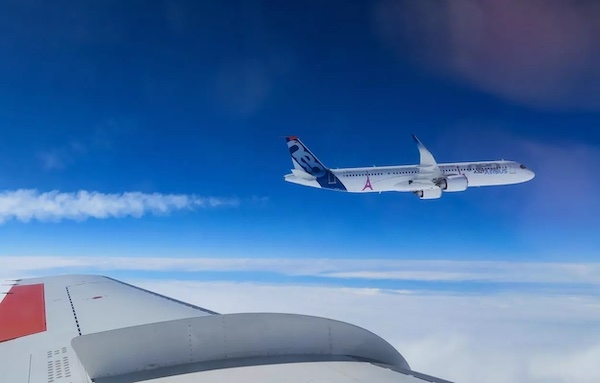
Airbus is continuing its testing of this bio-jet fuel with a new VOLCAN flight test campaign using the best-selling A320 Family aircraft. An A321neo took off today from Airbus’ headquarters in Toulouse, France with both of its engines powered by 100% unblended SAF. Since the end of February, the aircraft is being closely followed by a data-collecting aeroplane with the mission to gather information on the non-CO2 emissions and the creation of contrails. The A321neo’s flights are the latest demonstration in the VOLCAN project, the acronym of VOL avec Carburants Alternatifs Nouveaux, French for “Flight with new alternative fuels”.
Close-formation flight with partners
Airbus’ VOLCAN partners are the French aerospace companies Safran and Dassault Aviation, along with the ONERA aeronautics research laboratory and the French Ministry of Transport. The project is co-funded by CORAC, the French Council for Civil Aeronautical Research.
An A321neo version powered by LEAP-1A engines from CFM International is being used for the latest tests, and provides yet another opportunity to evaluate the potential benefits of unblended SAF versus conventional aviation fuel. This A321neo is the first Airbus single-aisle aircraft and the latest Airbus aircraft overall – following the A350 and A330MRTT – to test 100% sustainable aviation fuel on both engines.
To gather the important information from this flight, a ‘chase aircraft’, a highly modified Dassault jet from the German Aerospace Center, DLR is flown within 100 metres of the A321neo, using the testbed’s sensors to capture emissions data for detailed analysis.

Unblended SAF for VOLCAN flights
The VOLCAN evaluations are focused on the emissions of unblended SAF, which – unlike SAF blends that are increasingly being used in aviation today – is not mixed with any fossil fuels. Analysing the performance of unblended SAF and its promise in reducing emissions (CO2 and non-CO2) is an important step toward the decarbonisation of the aviation industry, and Airbus is once again taking a key role in such forward-looking research.
Currently, all Airbus commercial and military aircraft, as well as helicopters are capable of flying with an up to a 50% blend of SAF. The goal is to ensure 100% SAF capability by 2030 of these products. The potential to cut emissions by up to 80% compared to traditional jet fuel highlights the immense possibilities for SAF usage in the aviation sector.
Lufthansa Technik Engine Services (LTES) is significantly expanding its engine maintenance capabilities in Tulsa, Oklahoma, nearly doubling its operational capacity as part of its growth strategy acro...
Confidence among the world’s leading accredited aircraft dealers strengthened in the third quarter of 2026, reflecting continued momentum in the preowned business aviation market. According to t...
MTU Maintenance and Garuda Indonesia have entered into a three-year agreement for the maintenance, repair and overhaul of the airline’s GE90-115B engines, which power its fleet of eight Boeing 7...
Bombardier marked the 40th anniversary of its industry-leading Smart Services cost-per-flight-hour programs, which today support more than 1,500 enrolled aircraft and account for over 11 mil...

