

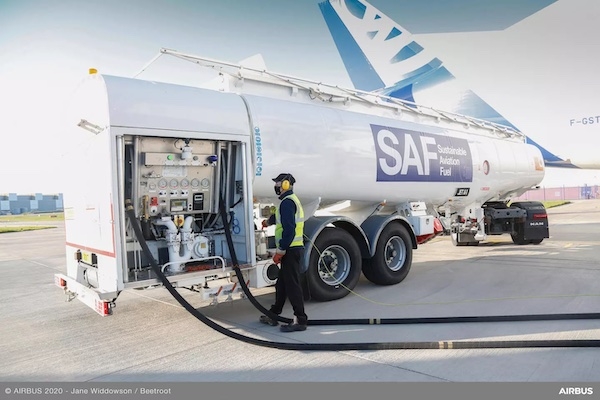
Airbus has become a strategic partner with DG Fuels, LLC (“DGF”), an emerging leader in sustainable aviation fuel. "Sustainable aviation fuels play a crucial role in enabling aviation's decarbonisation roadmap. We are committed to supporting all efforts that contribute to making them available at scale around the globe," said Airbus CEO Guillaume Faury. "The partnership with DG Fuels supports the emergence of a new technological pathway allowing for the production of SAFs from a broader range of waste and residue sources, first in the U.S with a potential for large-scale production worldwide."
DGF’s fuel production system is based entirely on cellulosic waste products, such as wood waste from the logging industry, and renewable energy sources, such as wind and solar power.DGF’s plant aims to have an initial production capacity of 120 million US gallons (454 million litres) of SAF per year on average, which could save approximately 1.5 million tonnes of CO2 emissions annually from 2026.
"The DGF team is excited to have finalised this SAF partnership with Airbus," commented Michael Darcy, Chairman and CEO at DG Fuels, "and we look forward to working together to accelerate the initial SAF facility in Louisiana and the subsequent scale up at various locations in the United States and beyond.”
The partnership with Airbus supports DG Fuels’ goal of launching the equity process and reaching a final investment decision (FID) on building DG Fuels’ first SAF plant in the United States. The decision would be expected by early 2024. In this context, Airbus and DGF have agreed for a portion of the production of the first plant to benefit Airbus’ customers.
This project is in line with the U.S. government-sponsored SAF Grand Challenge, which aims to reduce costs, improve sustainability and expand domestic SAF production. This national programme aims to produce 3 billion US gallons (11.3 billion litres) of domestic sustainable aviation fuel per year, achieving at least a 50% reduction in lifecycle greenhouse gas (GHG) emissions compared to conventional fuel by 2030 and 100% of projected aviation fuel consumption – or 35 billion US gallons of annual production - by 2050.
Bombardier announced plans to further expand its presence across the United States, with the creation of 800 jobs supported by ongoing growth initiatives and strategic infrastructure investments. ...
Lufthansa Technik Engine Services (LTES) is significantly expanding its engine maintenance capabilities in Tulsa, Oklahoma, nearly doubling its operational capacity as part of its growth strategy acro...
Confidence among the world’s leading accredited aircraft dealers strengthened in the third quarter of 2026, reflecting continued momentum in the preowned business aviation market. According to t...
Cirrus Aircraft has broken ground on a new 15,000-square-foot Engine Run-Up Center that will centralize engine testing, fuel calibration and certification activities for the SR Series, Vision Jet and...